Question 1
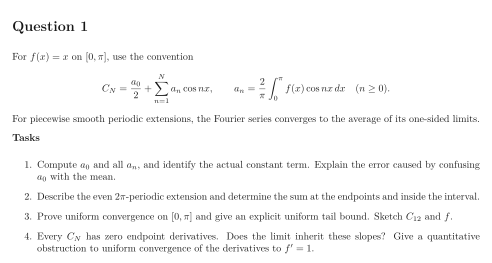
For on , use the convention For piecewise smooth periodic extensions, the Fourier series converges to the average of its one-sided limits.
Tasks
Compute and all , and identify the actual constant term. Explain the error caused by confusing with the mean.
Describe the even -periodic extension and determine the sum at the endpoints and inside the interval.
Prove uniform convergence on and give an explicit uniform tail bound. Sketch and .
Every has zero endpoint derivatives. Does the limit inherit these slopes? Give a quantitative obstruction to uniform convergence of the derivatives to .
Show solutionHide solution
Question 1 – Solution
Strategy. Separate the mean convention from positive-frequency normalization, and distinguish function convergence from derivative convergence.
Step 1: Compute the mean and coefficients. The zero-frequency integral gives , so the mean term is . Integration by parts for gives Even modes vanish; odd coefficients are . Using in place of adds the erroneous constant .
Step 2: Identify the extension and its limits. The extension is on , repeated with period . It is continuous, with corners at multiples of . At zero its two limits are zero; at both are . Therefore
Step 3: Bound the uniform error. The bound gives absolute uniform convergence by the Weierstrass test. The Fourier convergence theorem identifies the sum with , including the endpoints. For ,
Step 4: Reject an unjustified derivative limit. Every finite derivative is a sine sum, so . The target has one-sided endpoint derivatives one. Thus for every . Uniform convergence of functions alone does not permit differentiating the limit or passing endpoint derivative conditions to it.
See the diagram in the original worksheet below.
