Question 7
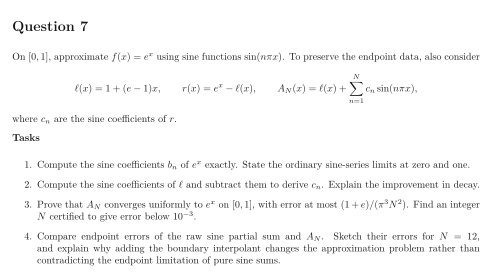
On , approximate using sine functions . To preserve the endpoint data, also consider where are the sine coefficients of .
Tasks
Compute the sine coefficients of exactly. State the ordinary sine-series limits at zero and one.
Compute the sine coefficients of and subtract them to derive . Explain the improvement in decay.
Prove that converges uniformly to on , with error at most . Find an integer certified to give error below .
Compare endpoint errors of the raw sine partial sum and . Sketch their errors for , and explain why adding the boundary interpolant changes the approximation problem rather than contradicting the endpoint limitation of pure sine sums.
Show solutionHide solution
Question 7 – Solution
Strategy. Remove the nonzero boundary values before asking a sine series for uniform approximation.
Step 1: Compute the raw coefficients. For , an antiderivative is . Evaluation gives The odd periodic extension has opposite one-sided values at each endpoint, so its jump averages are zero. Every raw sine partial sum is also zero there.
Step 2: Cancel the leading boundary contribution. Integration of the linear interpolant gives . Therefore The raw coefficients are of order , while are of order . The residual has zero values at both endpoints; the leading boundary term cancels.
Step 3: Establish a uniform certificate. Since , the residual series converges absolutely and uniformly. Its continuous piecewise smooth odd extension identifies the sum with throughout the closed interval. Thus For , the bound is below , so twelve modes suffice.
Step 4: Interpret the endpoint comparison. For the raw sum , equals one at zero and at one. For , both endpoint errors are exactly zero, and the entire error has the small bound above. The graph shows these two errors on the same scale. The corrected approximant includes the non-sine function ; it is not a pure sine sum and therefore is not constrained to vanish at the endpoints.
See the diagram in the original worksheet below.
