Question 9
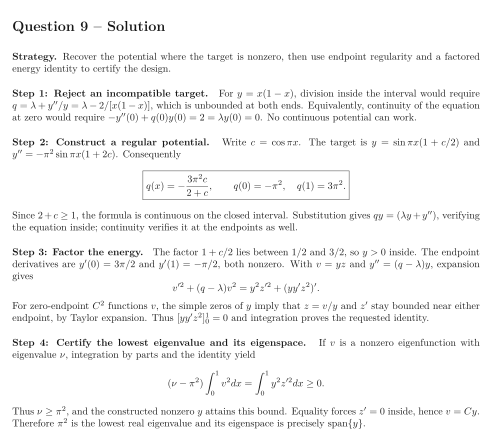
An inverse design seeks a continuous potential on for For the constructive part, prescribe and . Eigenfunctions are required to be .
Tasks
Show that the alternative target cannot be an eigenfunction for any continuous and any finite real . Explain the endpoint obstruction.
For the trigonometric target, recover explicitly and extend it continuously to both endpoints. Compute and and verify the differential equation.
Prove that the target is positive on and has simple endpoint zeros. For any test function with zero endpoints, put inside the interval and derive .
Use this identity to prove that no real eigenvalue can lie below , and that every eigenfunction with eigenvalue is a multiple of the designed target. Address the boundary term in the identity.
Show solutionHide solution
Question 9 – Solution
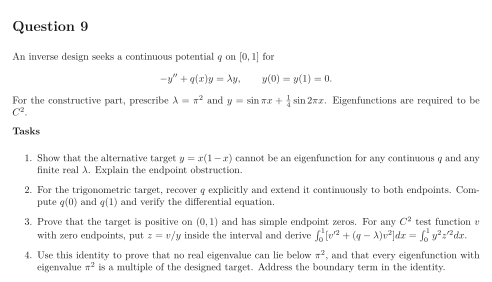
Strategy. Recover the potential where the target is nonzero, then use endpoint regularity and a factored energy identity to certify the design.
Step 1: Reject an incompatible target. For , division inside the interval would require , which is unbounded at both ends. Equivalently, continuity of the equation at zero would require . No continuous potential can work.
Step 2: Construct a regular potential. Write . The target is and . Consequently Since , the formula is continuous on the closed interval. Substitution gives , verifying the equation inside; continuity verifies it at the endpoints as well.
Step 3: Factor the energy. The factor lies between and , so inside. The endpoint derivatives are and , both nonzero. With and , expansion gives For zero-endpoint functions , the simple zeros of imply that and stay bounded near either endpoint, by Taylor expansion. Thus and integration proves the requested identity.
Step 4: Certify the lowest eigenvalue and its eigenspace. If is a nonzero eigenfunction with eigenvalue , integration by parts and the identity yield Thus , and the constructed nonzero attains this bound. Equality forces inside, hence . Therefore is the lowest real eigenvalue and its eigenspace is precisely .