Question 2
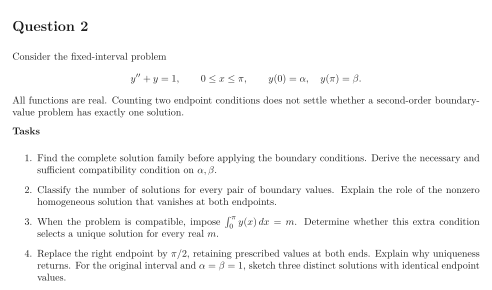
Consider the fixed-interval problem All functions are real. Counting two endpoint conditions does not settle whether a second-order boundary-value problem has exactly one solution.
Tasks
Find the complete solution family before applying the boundary conditions. Derive the necessary and sufficient compatibility condition on .
Classify the number of solutions for every pair of boundary values. Explain the role of the nonzero homogeneous solution that vanishes at both endpoints.
When the problem is compatible, impose . Determine whether this extra condition selects a unique solution for every real .
Replace the right endpoint by , retaining prescribed values at both ends. Explain why uniqueness returns. For the original interval and , sketch three distinct solutions with identical endpoint values.
Show solutionHide solution
Question 2 – Solution
Strategy. Test whether the endpoint equations independently determine the homogeneous constants.
Step 1: Derive compatibility. The general solution is . The left endpoint gives , while the right endpoint gives . Thus
Step 2: Count the compatible solutions. When compatible, the entire family is There are infinitely many solutions; otherwise there are none. There is never exactly one with just these two conditions. The nonzero homogeneous solution vanishes at both endpoints and can be added without changing the data.
Step 3: Use an integral normalization. Since the cosine integrates to zero and the sine integrates to two, For compatible endpoints, every real selects exactly one solution. If the endpoints are incompatible, an extra integral condition cannot fix that.
Step 4: Change the interval and compare. On , the right endpoint gives independently of , so every pair gives one solution. Independence of the endpoint equations, not their number alone, makes the difference. The graph on the original interval shows for .
See the diagram in the original worksheet below.
