Question 9
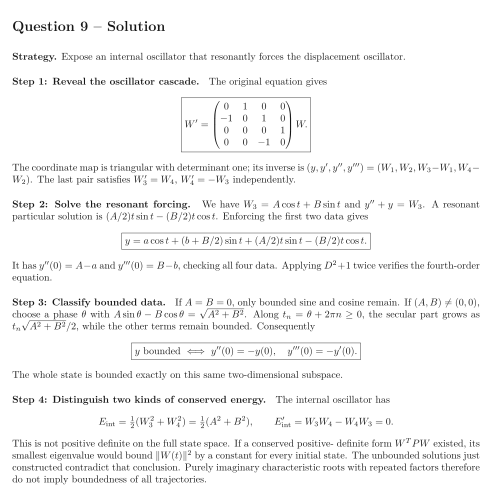
A fourth-order oscillator has a repeated quadratic factor: Introduce the state All four scalar initial derivatives are arbitrary real numbers.
Tasks
Derive the system for and show that this coordinate change is invertible. Identify the autonomous oscillator inside the system.
Write the full solution in terms of , , and .
Give necessary and sufficient conditions on the four initial derivatives for boundedness. Prove necessity even when the secular terms oscillate and have infinitely many zeros.
Find a conserved quadratic expression involving only the last two state coordinates. Decide whether the full four-state system can have a conserved positive-definite quadratic form, and justify your answer.
Show solutionHide solution
Question 9 – Solution
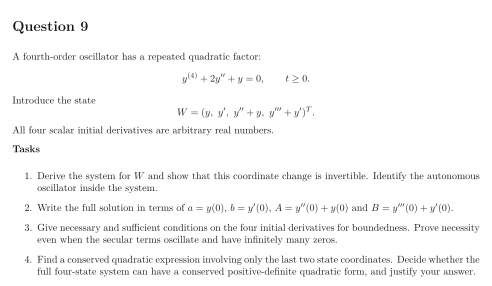
Strategy. Expose an internal oscillator that resonantly forces the displacement oscillator.
Step 1: Reveal the oscillator cascade. The original equation gives The coordinate map is triangular with determinant one; its inverse is . The last pair satisfies , independently.
Step 2: Solve the resonant forcing. We have and . A resonant particular solution is . Enforcing the first two data gives It has and , checking all four data. Applying twice verifies the fourth-order equation.
Step 3: Classify bounded data. If , only bounded sine and cosine remain. If , choose a phase with . Along , the secular part grows as , while the other terms remain bounded. Consequently The whole state is bounded exactly on this same two-dimensional subspace.
Step 4: Distinguish two kinds of conserved energy. The internal oscillator has This is not positive definite on the full state space. If a conserved positive- definite form existed, its smallest eigenvalue would bound by a constant for every initial state. The unbounded solutions just constructed contradict that conclusion. Purely imaginary characteristic roots with repeated factors therefore do not imply boundedness of all trajectories.