Question 3
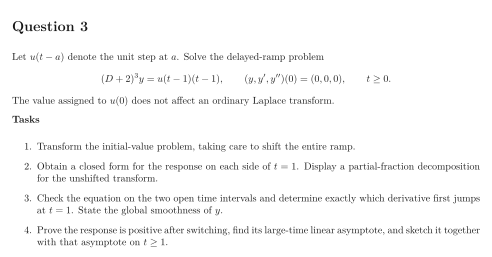
Let denote the unit step at . Solve the delayed-ramp problem The value assigned to does not affect an ordinary Laplace transform.
Tasks
Transform the initial-value problem, taking care to shift the entire ramp.
Obtain a closed form for the response on each side of . Display a partial-fraction decomposition for the unshifted transform.
Check the equation on the two open time intervals and determine exactly which derivative first jumps at . State the global smoothness of .
Prove the response is positive after switching, find its large-time linear asymptote, and sketch it together with that asymptote on .
Show solutionHide solution
Question 3 – Solution
Strategy. Solve a zero-state ramp response, then translate time and check the switching jet.
Step 1: Transform the shifted input. All initial terms vanish. The second shifting theorem gives
Step 2: Invert before translating. The unshifted fraction decomposes as Thus, with ,
Step 3: Verify forcing and regularity. The exponential term is annihilated by ; applying it to gives . Also as . Consequently match zero at switching, while . The solution is but not ; the original equation also holds at .
Step 4: Establish shape and asymptote. Convolution gives for . The exponential correction tends to zero, so the asymptote is , approached from above. It is drawn only for .
See the diagram in the original worksheet below.
