Question 8
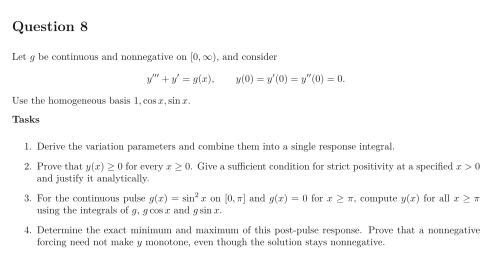
Let be continuous and nonnegative on , and consider Use the homogeneous basis .
Tasks
Derive the variation parameters and combine them into a single response integral.
Prove that for every . Give a sufficient condition for strict positivity at a specified and justify it analytically.
For the continuous pulse on and for , compute for all using the integrals of , and .
Determine the exact minimum and maximum of this post-pulse response. Prove that a nonnegative forcing need not make monotone, even though the solution stays nonnegative.
Show solutionHide solution
Question 8 – Solution
Strategy. Distinguish a nonnegative response kernel from the sign of its derivative.
Step 1: Compute the response kernel. The derivative matrix of has Wronskian . Its parameter equations give Integrating from zero and combining by the cosine difference identity yields The kernel and its first derivative vanish at zero, its second derivative is there, and its third plus first derivative vanishes. These facts verify the equation and zero data.
Step 2: Prove positivity without a monotonicity assumption. Both factors in the integrand are nonnegative. If for some , continuity gives an interval of positive forcing inside . The zeros of are isolated, so the integral is strictly positive. In particular, a continuous nonnegative forcing that is not identically zero on suffices.
Step 3: Evaluate the post-pulse moments. For the stated pulse, The first follows from the double-angle identity, the second from the derivative of , and the third by substituting . Thus For plotting the initial interval, evaluating the same kernel gives on ; its state matches the displayed branch at .
Step 4: Separate positivity from monotonicity. The post-pulse range is Both bounds are attained infinitely often; the lower bound is positive. Yet changes sign, and . Thus the nonnegative input gives a nonnegative response that continues oscillating after the pulse. Positivity of does not imply positivity of its derivative .
See the diagram in the original worksheet below.
