Question 2
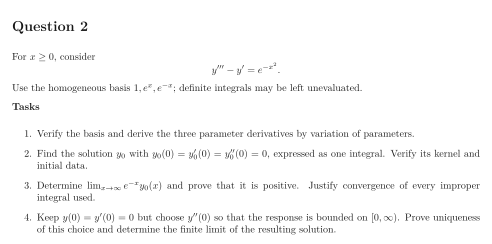
For , consider Use the homogeneous basis ; definite integrals may be left unevaluated.
Tasks
Verify the basis and derive the three parameter derivatives by variation of parameters.
Find the solution with , expressed as one integral. Verify its kernel and initial data.
Determine and prove that it is positive. Justify convergence of every improper integral used.
Keep but choose so that the response is bounded on . Prove uniqueness of this choice and determine the finite limit of the resulting solution.
Show solutionHide solution
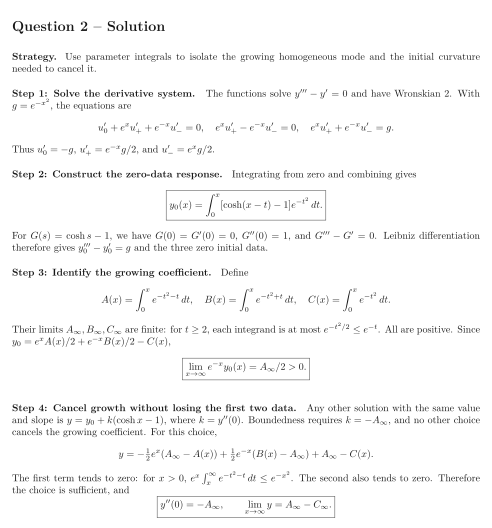
Question 2 – Solution
Strategy. Use parameter integrals to isolate the growing homogeneous mode and the initial curvature needed to cancel it.
Step 1: Solve the derivative system. The functions solve and have Wronskian . With , the equations are Thus , , and .
Step 2: Construct the zero-data response. Integrating from zero and combining gives For , we have , , and . Leibniz differentiation therefore gives and the three zero initial data.
Step 3: Identify the growing coefficient. Define Their limits are finite: for , each integrand is at most . All are positive. Since ,
Step 4: Cancel growth without losing the first two data. Any other solution with the same value and slope is , where . Boundedness requires , and no other choice cancels the growing coefficient. For this choice, The first term tends to zero: for , . The second also tends to zero. Therefore the choice is sufficient, and