Question 8
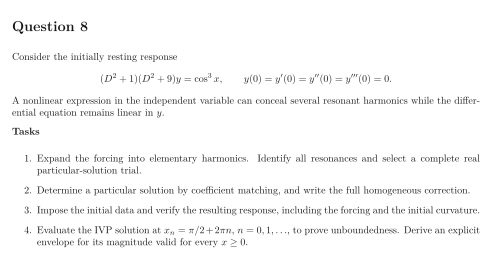
Consider the initially resting response A nonlinear expression in the independent variable can conceal several resonant harmonics while the differential equation remains linear in .
Tasks
Expand the forcing into elementary harmonics. Identify all resonances and select a complete real particular-solution trial.
Determine a particular solution by coefficient matching, and write the full homogeneous correction.
Impose the initial data and verify the resulting response, including the forcing and the initial curvature.
Evaluate the IVP solution at , , to prove unboundedness. Derive an explicit envelope for its magnitude valid for every .
Show solutionHide solution
Question 8 – Solution
Strategy. Expand the trigonometric product before choosing resonance factors.
Step 1: Expose both forcing frequencies. The identity reveals simple resonance at both and . A full trial is There is no nonlinear dependence on the unknown ; the right-hand side is a known function of .
Step 2: Match each harmonic. For , differentiation gives and . The cosine-weighted partners generate sine forcing and therefore have zero coefficients. Thus The residual is .
Step 3: Correct the initial curvature. The particular term is even, has value zero, and has . The zero data require , , and . Hence Here . The cosine correction has second derivative at zero and cancels the particular curvature; evenness verifies the odd initial derivatives.
Step 4: Prove growth and a global envelope. At , the sine values are and both cosines vanish, so . Also , whose absolute value is at most . Therefore The displayed envelopes are bounds, not assertions that equality holds at every point.
See the diagram in the original worksheet below.
