Question 9
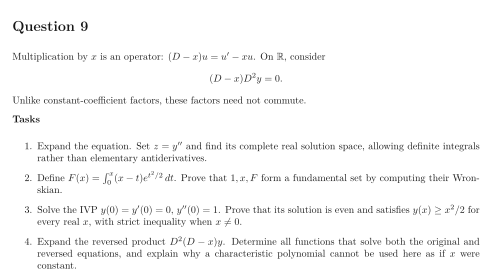
Multiplication by is an operator: . On , consider Unlike constant-coefficient factors, these factors need not commute.
Tasks
Expand the equation. Set and find its complete real solution space, allowing definite integrals rather than elementary antiderivatives.
Define . Prove that form a fundamental set by computing their Wronskian.
Solve the IVP , . Prove that its solution is even and satisfies for every real , with strict inequality when .
Expand the reversed product . Determine all functions that solve both the original and reversed equations, and explain why a characteristic polynomial cannot be used here as if were constant.
Show solutionHide solution
Question 9 – Solution
Strategy. Solve the factors in their given order and use the product rule when reversing them.
Step 1: Reduce the original equation. Expansion gives . Thus and . Integrating twice from zero yields This formula holds for negative as well, with the usual oriented integral.
Step 2: Verify the fundamental set. Differentiating the integral gives and , so . The derivative matrix is triangular: These are three independent solutions of a regular third-order linear equation, hence a fundamental set on .
Step 3: Fit and analyze the initial data. Since and , the IVP gives . Its second derivative is even, and its value and slope at zero vanish; integrating shows that is even. For , The inequality follows because the integrand is positive for . Evenness proves the same strict inequality for ; equality holds at zero.
Step 4: Respect the order of the factors. The product rule gives Subtracting the two equations forces for any common solution. Conversely, every constant solves both, so their common space consists exactly of constants. The variable coefficient creates the extra term; treating as a fixed characteristic root would discard it and give an invalid method.
See the diagram in the original worksheet below.
