Question 7
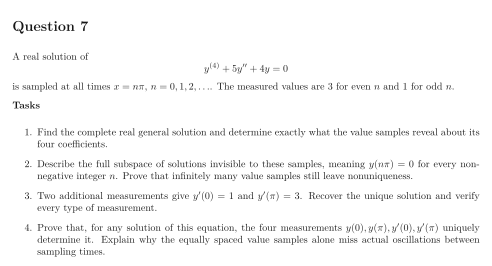
A real solution of is sampled at all times , . The measured values are for even and for odd .
Tasks
Find the complete real general solution and determine exactly what the value samples reveal about its four coefficients.
Describe the full subspace of solutions invisible to these samples, meaning for every nonnegative integer . Prove that infinitely many value samples still leave nonuniqueness.
Two additional measurements give and . Recover the unique solution and verify every type of measurement.
Prove that, for any solution of this equation, the four measurements uniquely determine it. Explain why the equally spaced value samples alone miss actual oscillations between sampling times.
Show solutionHide solution
Question 7 – Solution
Strategy. Evaluate the real modes at the sampling grid before interpreting the amount of information in the data.
Step 1: Read the visible coefficients. The polynomial is , so At the sample times, . Thus and , giving and . These samples impose no restriction on .
Step 2: Find the invisible subspace. Zero values at both even and odd sample indices force , while the sine modes vanish at every . Therefore It has dimension two. Adding any member to one fitting signal leaves every recorded value unchanged, even though the functions differ between samples.
Step 3: Recover the missing oscillations. The derivative samples give and , hence . The unique signal is Its value samples are and its derivative samples at are , respectively. Every term solves the equation.
Step 4: Prove general identifiability. For arbitrary measurements , , and , These formulas exist and are unique for every real measurement vector. Value samples alone repeat only two linear constraints; their number does not restore the sine information. The figure displays the two independent invisible modes and their common sample zeros.
See the diagram in the original worksheet below.
