Question 7
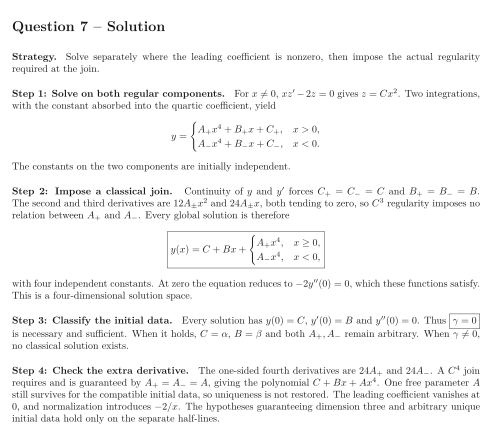
Consider the singular third-order equation on the whole real line. A classical solution here means a function satisfying the original equation at every point, including .
Tasks
Solve on each half-line by first setting . Display all constants before matching across zero.
Classify every global solution and determine the dimension of this solution space.
For prescribed , , , determine exactly when solutions exist and how many free parameters remain.
Determine which global solutions are . Does demanding this extra derivative restore uniqueness for compatible initial data at zero? Explain why the regular third-order dimension theorem cannot be used across this singular point.
Show solutionHide solution
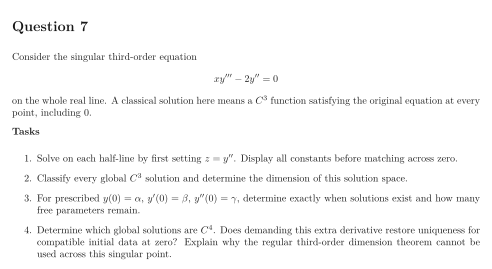
Question 7 – Solution
Strategy. Solve separately where the leading coefficient is nonzero, then impose the actual regularity required at the join.
Step 1: Solve on both regular components. For , gives . Two integrations, with the constant absorbed into the quartic coefficient, yield The constants on the two components are initially independent.
Step 2: Impose a classical join. Continuity of and forces and . The second and third derivatives are and , both tending to zero, so regularity imposes no relation between and . Every global solution is therefore with four independent constants. At zero the equation reduces to , which these functions satisfy. This is a four-dimensional solution space.
Step 3: Classify the initial data. Every solution has , and . Thus is necessary and sufficient. When it holds, , and both remain arbitrary. When , no classical solution exists.
Step 4: Check the extra derivative. The one-sided fourth derivatives are and . A join requires and is guaranteed by , giving the polynomial . One free parameter still survives for the compatible initial data, so uniqueness is not restored. The leading coefficient vanishes at , and normalization introduces . The hypotheses guaranteeing dimension three and arbitrary unique initial data hold only on the separate half-lines.