Question 2
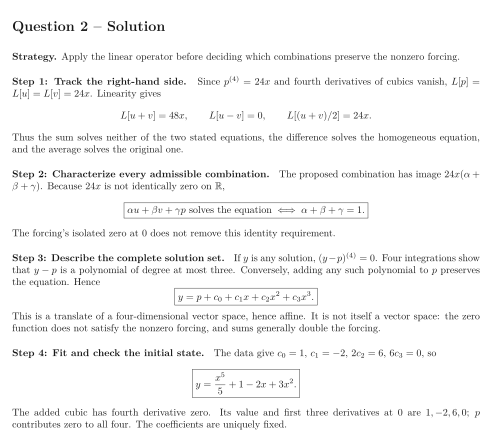
Let and consider on . Define For a nonhomogeneous equation, the phrase “superposition of solutions” needs a precise qualification.
Tasks
Verify that solve the equation. Determine whether , and solve the same equation or its homogeneous counterpart.
Find every triple for which solves .
Prove that the complete solution set is plus the space of cubic polynomials. Explain why it is an affine set but not a vector space.
Find the unique solution with , , , , and verify the forcing and all four data.
Show solutionHide solution
Question 2 – Solution
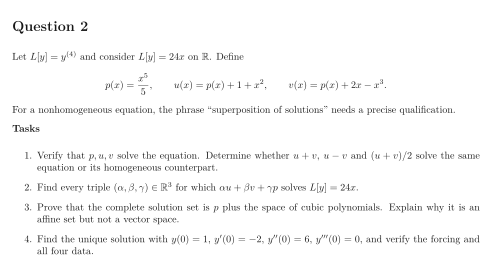
Strategy. Apply the linear operator before deciding which combinations preserve the nonzero forcing.
Step 1: Track the right-hand side. Since and fourth derivatives of cubics vanish, . Linearity gives Thus the sum solves neither of the two stated equations, the difference solves the homogeneous equation, and the average solves the original one.
Step 2: Characterize every admissible combination. The proposed combination has image . Because is not identically zero on , The forcing’s isolated zero at does not remove this identity requirement.
Step 3: Describe the complete solution set. If is any solution, . Four integrations show that is a polynomial of degree at most three. Conversely, adding any such polynomial to preserves the equation. Hence This is a translate of a four-dimensional vector space, hence affine. It is not itself a vector space: the zero function does not satisfy the nonzero forcing, and sums generally double the forcing.
Step 4: Fit and check the initial state. The data give , , , , so The added cubic has fourth derivative zero. Its value and first three derivatives at are ; contributes zero to all four. The coefficients are uniquely fixed.