Question 10
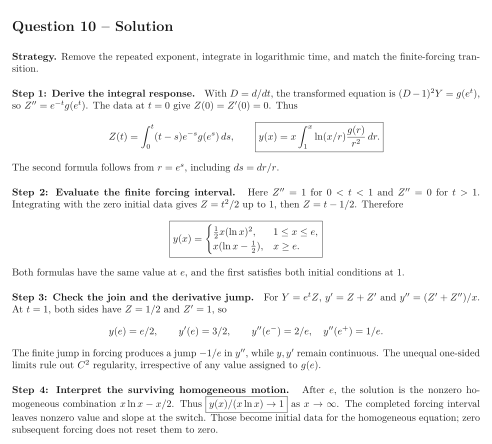
For , consider a finite interval of forcing in an Euler equation: Seek a solution that is across and solves the equation on each side. No classical second derivative at the switching point is assumed.
Tasks
Set and . Derive a general definite-integral solution for zero initial data, valid for piecewise continuous forcing .
Apply it to the specified forcing and give explicit formulas on and .
Verify continuity of and at . Compute the one-sided second derivatives and explain why a solution at that point is impossible.
Determine the large- behavior after the forcing stops. Explain why the solution does not return to zero just because the right-hand side becomes zero.
Show solutionHide solution
Question 10 – Solution
Strategy. Remove the repeated exponent, integrate in logarithmic time, and match the finite-forcing transition.
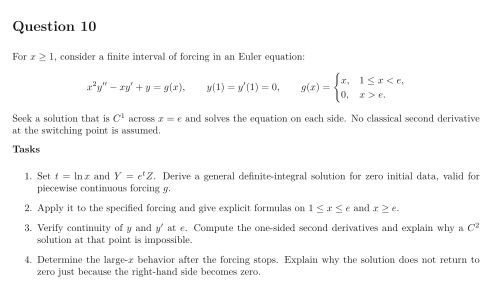
Step 1: Derive the integral response. With , the transformed equation is , so . The data at give . Thus The second formula follows from , including .
Step 2: Evaluate the finite forcing interval. Here for and for . Integrating with the zero initial data gives up to , then . Therefore Both formulas have the same value at , and the first satisfies both initial conditions at .
Step 3: Check the join and the derivative jump. For , and . At , both sides have and , so The finite jump in forcing produces a jump in , while remain continuous. The unequal one-sided limits rule out regularity, irrespective of any value assigned to .
Step 4: Interpret the surviving homogeneous motion. After , the solution is the nonzero homogeneous combination . Thus as . The completed forcing interval leaves nonzero value and slope at the switch. Those become initial data for the homogeneous equation; zero subsequent forcing does not reset them to zero.