Question 8
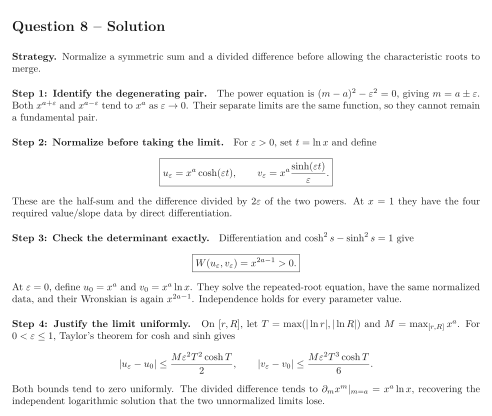
For fixed and parameter , consider on Two distinct power solutions become nearly identical when their characteristic exponents approach one another.
Tasks
Find the characteristic exponents for and explain why simply taking their two power solutions to the limit does not produce a fundamental pair at .
Construct solutions satisfying , , , .
Compute their Wronskian and prove independence for every , using the limiting pair at zero.
Determine that limiting pair and justify uniform convergence of each basis function on every compact interval as . Explain how the logarithmic repeated-root solution emerges.
Show solutionHide solution
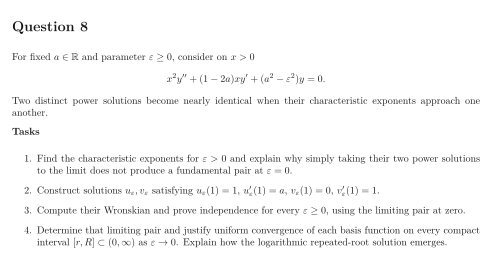
Question 8 – Solution
Strategy. Normalize a symmetric sum and a divided difference before allowing the characteristic roots to merge.
Step 1: Identify the degenerating pair. The power equation is , giving . Both and tend to as . Their separate limits are the same function, so they cannot remain a fundamental pair.
Step 2: Normalize before taking the limit. For , set and define These are the half-sum and the difference divided by of the two powers. At they have the four required value/slope data by direct differentiation.
Step 3: Check the determinant exactly. Differentiation and give At , define and . They solve the repeated-root equation, have the same normalized data, and their Wronskian is again . Independence holds for every parameter value.
Step 4: Justify the limit uniformly. On , let and . For , Taylor’s theorem for and gives Both bounds tend to zero uniformly. The divided difference tends to , recovering the independent logarithmic solution that the two unnormalized limits lose.