Question 1
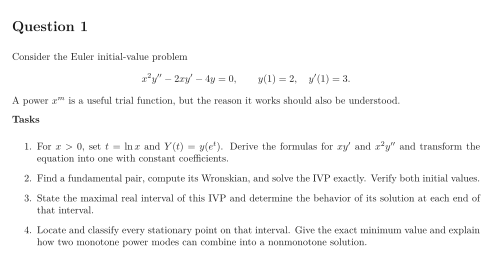
Consider the Euler initial-value problem A power is a useful trial function, but the reason it works should also be understood.
Tasks
For , set and . Derive the formulas for and and transform the equation into one with constant coefficients.
Find a fundamental pair, compute its Wronskian, and solve the IVP exactly. Verify both initial values.
State the maximal real interval of this IVP and determine the behavior of its solution at each end of that interval.
Locate and classify every stationary point on that interval. Give the exact minimum value and explain how two monotone power modes can combine into a nonmonotone solution.
Show solutionHide solution
Question 1 – Solution
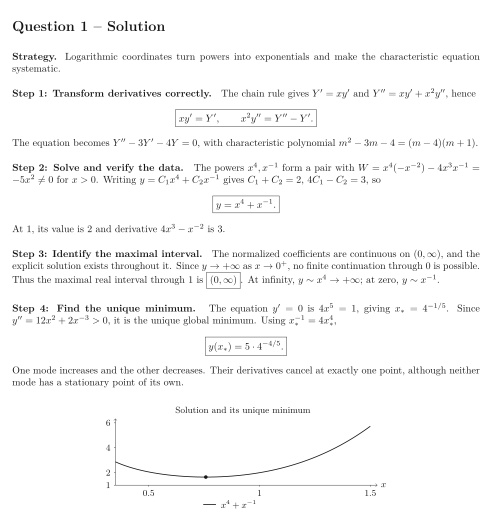
Strategy. Logarithmic coordinates turn powers into exponentials and make the characteristic equation systematic.
Step 1: Transform derivatives correctly. The chain rule gives and , hence The equation becomes , with characteristic polynomial .
Step 2: Solve and verify the data. The powers form a pair with for . Writing gives , , so At , its value is and derivative is .
Step 3: Identify the maximal interval. The normalized coefficients are continuous on , and the explicit solution exists throughout it. Since as , no finite continuation through is possible. Thus the maximal real interval through is . At infinity, ; at zero, .
Step 4: Find the unique minimum. The equation is , giving . Since , it is the unique global minimum. Using , One mode increases and the other decreases. Their derivatives cancel at exactly one point, although neither mode has a stationary point of its own.
See the diagram in the original worksheet below.