Question 10
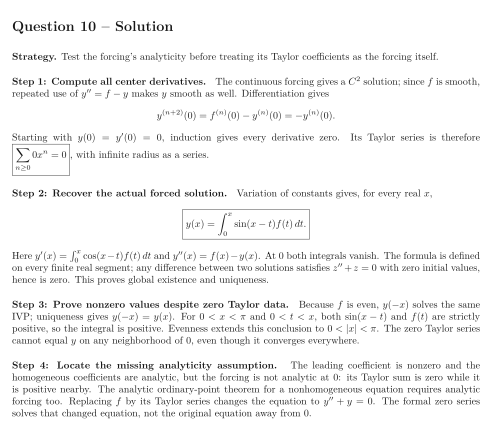
Let You may use the established facts that is infinitely differentiable, even, positive away from , and for every .
Tasks
Determine every derivative of the solution at . What Taylor series does formal coefficient matching produce?
Derive a definite-integral representation of the actual solution and verify the equation and both initial values. Explain its existence and uniqueness on the whole real line.
Prove that the solution is even and strictly positive for . What does this imply about whether its Taylor series represents it near ?
A student argues that constant coefficients make an ordinary point, so the Taylor method must work. Identify the missing hypothesis and distinguish a solution of the formally expanded equation from a solution of the original equation.
Show solutionHide solution
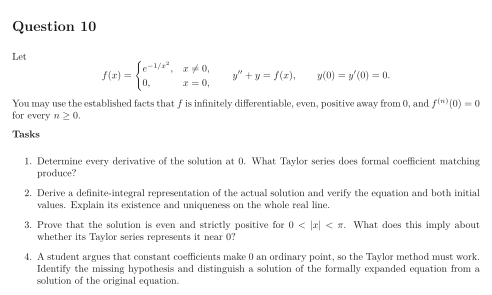
Question 10 – Solution
Strategy. Test the forcing’s analyticity before treating its Taylor coefficients as the forcing itself.
Step 1: Compute all center derivatives. The continuous forcing gives a solution; since is smooth, repeated use of makes smooth as well. Differentiation gives Starting with , induction gives every derivative zero. Its Taylor series is therefore , with infinite radius as a series.
Step 2: Recover the actual forced solution. Variation of constants gives, for every real , Here and . At both integrals vanish. The formula is defined on every finite real segment; any difference between two solutions satisfies with zero initial values, hence is zero. This proves global existence and uniqueness.
Step 3: Prove nonzero values despite zero Taylor data. Because is even, solves the same IVP; uniqueness gives . For and , both and are strictly positive, so the integral is positive. Evenness extends this conclusion to . The zero Taylor series cannot equal on any neighborhood of , even though it converges everywhere.
Step 4: Locate the missing analyticity assumption. The leading coefficient is nonzero and the homogeneous coefficients are analytic, but the forcing is not analytic at : its Taylor sum is zero while it is positive nearby. The analytic ordinary-point theorem for a nonhomogeneous equation requires analytic forcing too. Replacing by its Taylor series changes the equation to . The formal zero series solves that changed equation, not the original equation away from .