Question 9
For a power-series approximation is to be certified on . For a trial function , define its differential residual by .
Tasks
Derive the coefficient recurrence and construct the degree-seven Taylor polynomial of the exact solution.
Compute exactly. Derive a definite-integral formula for the error from its differential equation and initial values.
Prove the signed error enclosure on . Identify the exact solution and compare this certificate with the alternating Taylor remainder.
Show that the residual alone cannot control approximation error if initial data are not also checked. Construct trial functions with the same residual as but arbitrarily large error at .
Show solutionHide solution
Question 9 – Solution
Strategy. Convert the residual into a forced error equation, keeping track of both initial errors.
Step 1: Construct the solution truncation. Matching powers gives , with . Thus all even coefficients vanish and
Step 2: Derive the error equation. Direct differentiation yields . Since satisfies both initial values, with . The zero-data solution is Differentiating this integral twice verifies the equation and the two initial conditions, so uniqueness proves the formula.
Step 3: Bound the signed integral. For , . Therefore The exact solution is , as substitution and initial values verify. Its convergent sine expansion has first omitted term , so the alternating estimate agrees with the integral certificate. For the integral is strictly positive before its minus sign, giving .
Step 4: Expose the role of initial data. Let for any real . Since , every has exactly the same residual. But , and is unbounded as . Residual size certifies error only together with suitable initial or boundary errors and a stability estimate.
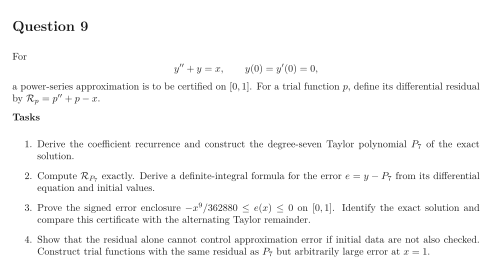
See the diagram in the original worksheet below.