Question 2
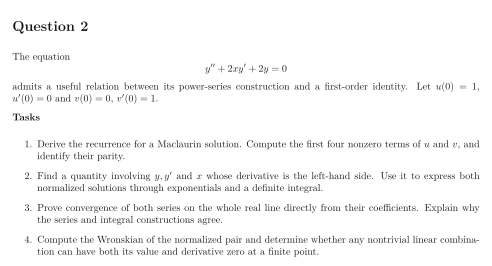
The equation admits a useful relation between its power-series construction and a first-order identity. Let , and , .
Tasks
Derive the recurrence for a Maclaurin solution. Compute the first four nonzero terms of and , and identify their parity.
Find a quantity involving and whose derivative is the left-hand side. Use it to express both normalized solutions through exponentials and a definite integral.
Prove convergence of both series on the whole real line directly from their coefficients. Explain why the series and integral constructions agree.
Compute the Wronskian of the normalized pair and determine whether any nontrivial linear combination can have both its value and derivative zero at a finite point.
Show solutionHide solution
Question 2 – Solution
Strategy. Compare the even and odd coefficient chains with an integrated form of the equation.
Step 1: Separate the two chains. Coefficient matching gives , so Thus is even, while is odd.
Step 2: Integrate a conserved quantity. Since , . At , . Multiplying by and integrating gives Consequently .
Step 3: Justify convergence and equality. The even coefficients are , and the odd ones are , where . Successive nonzero term ratios are and , respectively; both tend to zero. Thus the series define solutions for all real . The integral formulas solve the same equation with the same initial data, so uniqueness identifies the constructions.
Step 4: Test independence at every point. Differentiating gives , while . Hence At any finite point, the two-by-two system for the coefficients of a combination with zero value and derivative has nonzero determinant. Both coefficients must vanish. The plotted pair remains independent even where one curve crosses zero.
See the diagram in the original worksheet below.
