Question 1
Consider the differential equation near . Write ; the coefficients are not the derivatives themselves.
Tasks
Derive the coefficient recurrence, stating the exceptional equation at degree zero. Explain how the indices split into three chains.
Construct the normalized solutions , and , . Give the first four nonzero terms of each.
Prove that both series converge for every real and form a fundamental pair. State the solution with arbitrary initial values , .
For the degree-nine truncation of , prove a uniform error bound below on . A numerical sample of the error is not a proof of this bound.
Show solutionHide solution
Question 1 – Solution
Strategy. Keep the lowest index separate, then use the recurrence both to construct solutions and to bound their tails.
Step 1: Align the powers. The constant coefficient gives . For , , equivalently The chains start at ; the last is identically zero.
Step 2: Build the normalized series. With empty products interpreted as ,
Step 3: Establish actual solutions and independence. For either series, the ratio of consecutive nonzero term magnitudes tends to zero at every fixed . Thus both have infinite radius, may be differentiated termwise, and satisfy the equation and stated initial data. Their Wronskian satisfies and . Hence is the unique solution for those initial values, on .
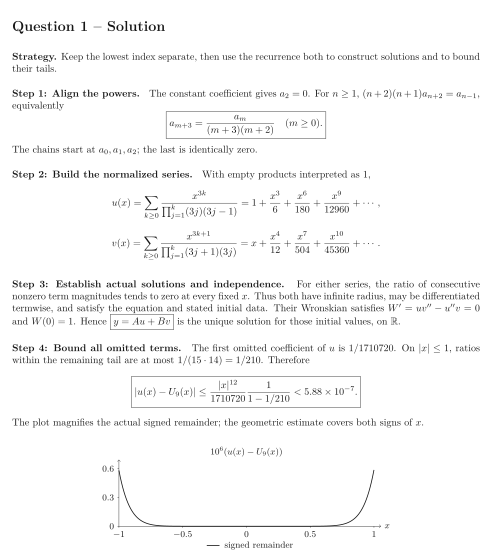
Step 4: Bound all omitted terms. The first omitted coefficient of is . On , ratios within the remaining tail are at most . Therefore The plot magnifies the actual signed remainder; the geometric estimate covers both signs of .
See the diagram in the original worksheet below.