Question 10
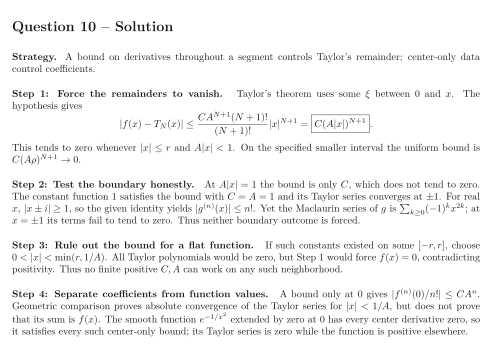
Let , with , and suppose constants satisfy Write . For a boundary example you may use and the identity
Tasks
Prove that for with . Give a uniform error estimate on when and .
Explain why this argument gives no conclusion at . Show that both convergence and divergence there are possible under the stated derivative hypothesis, using and on with .
A function has all derivatives zero at but is positive at every nearby nonzero point. Prove it cannot obey such a derivative bound on any neighborhood of .
Suppose the displayed bound is known only at . What can you conclude about convergence of the Taylor series, and what additional conclusion can you no longer justify? Supply a counterexample.
Show solutionHide solution
Question 10 – Solution
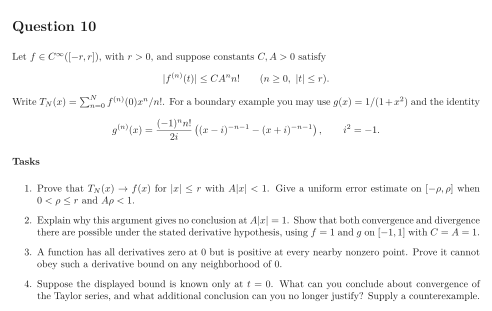
Strategy. A bound on derivatives throughout a segment controls Taylor’s remainder; center-only data control coefficients.
Step 1: Force the remainders to vanish. Taylor’s theorem uses some between and . The hypothesis gives This tends to zero whenever and . On the specified smaller interval the uniform bound is .
Step 2: Test the boundary honestly. At the bound is only , which does not tend to zero. The constant function satisfies the bound with and its Taylor series converges at . For real , , so the given identity yields . Yet the Maclaurin series of is ; at its terms fail to tend to zero. Thus neither boundary outcome is forced.
Step 3: Rule out the bound for a flat function. If such constants existed on some , choose . All Taylor polynomials would be zero, but Step 1 would force , contradicting positivity. Thus no finite positive can work on any such neighborhood.
Step 4: Separate coefficients from function values. A bound only at gives . Geometric comparison proves absolute convergence of the Taylor series for , but does not prove that its sum is . The smooth function extended by zero at has every center derivative zero, so it satisfies every such center-only bound; its Taylor series is zero while the function is positive elsewhere.