Question 7
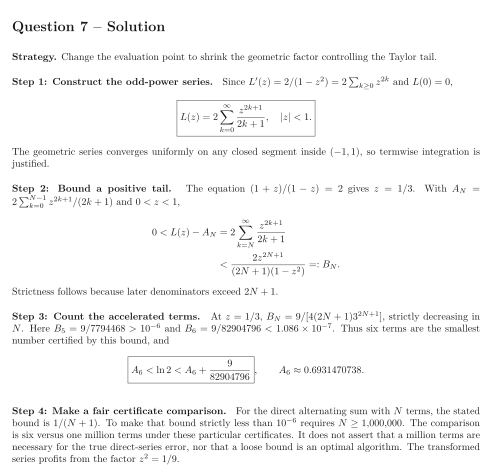
The direct Maclaurin expansion of converges slowly at . Seek a faster Taylor-series evaluation of using Count terms by the number of nonzero summands, not by polynomial degree.
Tasks
Derive the Maclaurin series for by differentiating and integrating a geometric series, with a justification on .
Select a positive for which . For the first terms, prove the tail bound and determine the error sign.
Find the smallest for which this bound is strictly below at the selected . Give the resulting approximation and a rigorous enclosure.
For the direct alternating harmonic sum with terms, how many terms does the next-term bound require to certify error strictly below ? Compare the two certificates and explain the limits of this comparison.
Show solutionHide solution
Question 7 – Solution
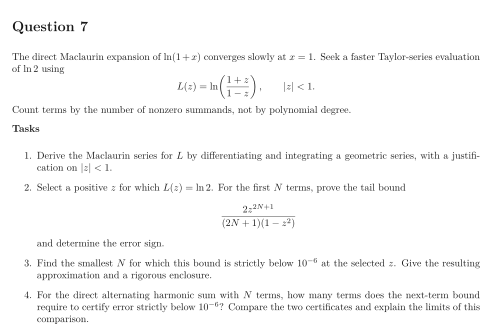
Strategy. Change the evaluation point to shrink the geometric factor controlling the Taylor tail.
Step 1: Construct the odd-power series. Since and , The geometric series converges uniformly on any closed segment inside , so termwise integration is justified.
Step 2: Bound a positive tail. The equation gives . With and , Strictness follows because later denominators exceed .
Step 3: Count the accelerated terms. At , , strictly decreasing in . Here and . Thus six terms are the smallest number certified by this bound, and
Step 4: Make a fair certificate comparison. For the direct alternating sum with terms, the stated bound is . To make that bound strictly less than requires . The comparison is six versus one million terms under these particular certificates. It does not assert that a million terms are necessary for the true direct-series error, nor that a loose bound is an optimal algorithm. The transformed series profits from the factor .