Question 7
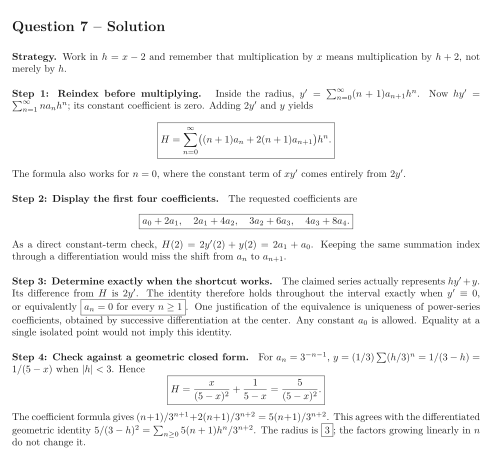
Suppose has positive radius . Consider only for . A student claims that .
Tasks
Derive the correct coefficient of in for every , reindexing the derivative carefully.
Write the constant, linear, quadratic and cubic coefficients explicitly in terms of the .
Identify the student’s missing contribution and characterize exactly which series make the claimed identity valid throughout the open interval.
Apply your formula to . Sum geometrically, compute directly from this closed form, and verify the coefficients agree. State the resulting series’ radius.
Show solutionHide solution
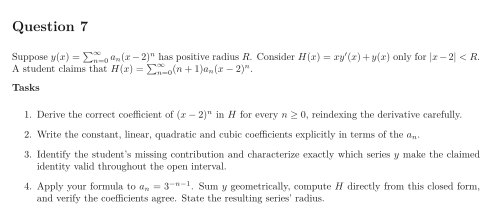
Question 7 – Solution
Strategy. Work in and remember that multiplication by means multiplication by , not merely by .
Step 1: Reindex before multiplying. Inside the radius, . Now ; its constant coefficient is zero. Adding and yields The formula also works for , where the constant term of comes entirely from .
Step 2: Display the first four coefficients. The requested coefficients are As a direct constant-term check, . Keeping the same summation index through a differentiation would miss the shift from to .
Step 3: Determine exactly when the shortcut works. The claimed series actually represents . Its difference from is . The identity therefore holds throughout the interval exactly when , or equivalently . One justification of the equivalence is uniqueness of power-series coefficients, obtained by successive differentiation at the center. Any constant is allowed. Equality at a single isolated point would not imply this identity.
Step 4: Check against a geometric closed form. For , when . Hence The coefficient formula gives . This agrees with the differentiated geometric identity . The radius is ; the factors growing linearly in do not change it.