Question 3
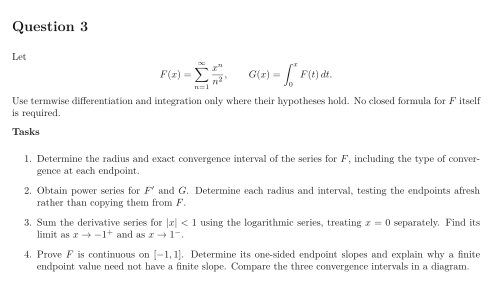
Let Use termwise differentiation and integration only where their hypotheses hold. No closed formula for itself is required.
Tasks
Determine the radius and exact convergence interval of the series for , including the type of convergence at each endpoint.
Obtain power series for and . Determine each radius and interval, testing the endpoints afresh rather than copying them from .
Sum the derivative series for using the logarithmic series, treating separately. Find its limit as and as .
Prove is continuous on . Determine its one-sided endpoint slopes and explain why a finite endpoint value need not have a finite slope. Compare the three convergence intervals in a diagram.
Show solutionHide solution
Question 3 – Solution
Strategy. Differentiation and integration preserve the radius but can alter endpoints; continuity and the mean value theorem settle endpoint slopes.
Step 1: Check the original series. The ratio test gives . At and , the absolute values sum to . Thus , absolutely throughout. For the terms do not tend to zero.
Step 2: Differentiate and integrate inside the radius. For , The constant in is zero because . Both new radii are . For the derivative series, gives harmonic divergence; gives conditional alternating convergence. Hence . The integrated series converges absolutely at both endpoints, so . Here these interval labels refer to the displayed series, not an assumed endpoint differentiation rule.
Step 3: Sum the derivative in the open interval. Using gives The value at zero follows from the constant term and also from the limit. Consequently , whereas .
Step 4: Justify what happens at the boundary. Since on , the uniform majorant test gives uniform convergence there and continuity of . Apply the mean value theorem between an interior point and either endpoint. The intervening derivative then tends to the corresponding limit found above. Therefore So the finite value has no finite left derivative. Endpoint behavior must be proved separately even when the power-series radius is unchanged.
See the diagram in the original worksheet below.
