Question 1
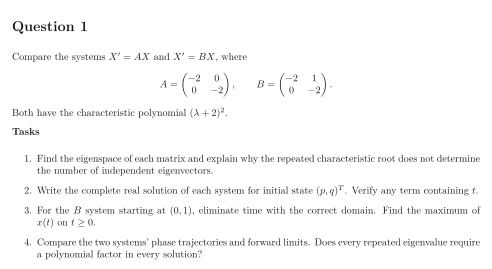
Compare the systems and , where Both have the characteristic polynomial .
Tasks
Find the eigenspace of each matrix and explain why the repeated characteristic root does not determine the number of independent eigenvectors.
Write the complete real solution of each system for initial state . Verify any term containing .
For the system starting at , eliminate time with the correct domain. Find the maximum of on .
Compare the two systems’ phase trajectories and forward limits. Does every repeated eigenvalue require a polynomial factor in every solution?
Show solutionHide solution
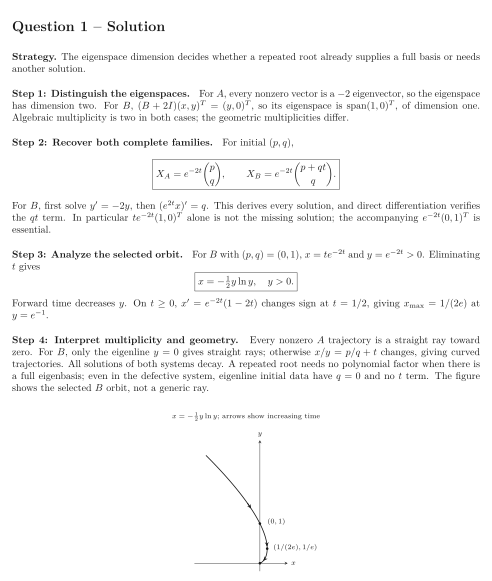
Question 1 – Solution
Strategy. The eigenspace dimension decides whether a repeated root already supplies a full basis or needs another solution.
Step 1: Distinguish the eigenspaces. For , every nonzero vector is a eigenvector, so the eigenspace has dimension two. For , , so its eigenspace is , of dimension one. Algebraic multiplicity is two in both cases; the geometric multiplicities differ.
Step 2: Recover both complete families. For initial , For , first solve , then . This derives every solution, and direct differentiation verifies the term. In particular alone is not the missing solution; the accompanying is essential.
Step 3: Analyze the selected orbit. For with , and . Eliminating gives Forward time decreases . On , changes sign at , giving at .
Step 4: Interpret multiplicity and geometry. Every nonzero trajectory is a straight ray toward zero. For , only the eigenline gives straight rays; otherwise changes, giving curved trajectories. All solutions of both systems decay. A repeated root needs no polynomial factor when there is a full eigenbasis; even in the defective system, eigenline initial data have and no term. The figure shows the selected orbit, not a generic ray.
See the diagram in the original worksheet below.