Question 2
Consider A student sees eigenvalues and claims that the trajectory must be a circle rotating with constant Euclidean angular speed .
Tasks
Find the eigenvalues and solve the IVP in real form.
Find a conserved positive quadratic expression and determine the complete phase curve. Locate its intercepts.
Find the least positive period and the direction of traversal. Identify coordinates in which the motion is a uniform circular rotation.
Compute the original Euclidean angular velocity . Find its range on the orbit and evaluate the student’s claim.
Show solutionHide solution
Question 2 – Solution
Strategy. A linear coordinate change can turn a circle into an ellipse while preserving elapsed time and period.
Step 1: Solve the oscillatory IVP. The characteristic polynomial is , giving . From and , Differentiation verifies both first-order equations and the initial data.
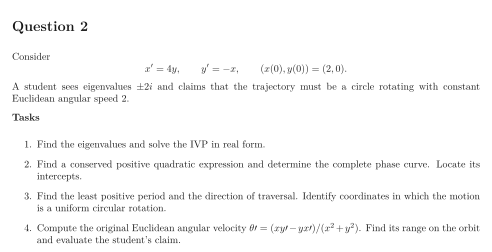
Step 2: Recover the invariant ellipse. The derivative of is . Thus the orbit is , with intercepts and . The parametrization covers the whole ellipse. Its unequal semiaxes must remain unequal in an equal-scale drawing; it is not a circle in the original Euclidean coordinates.
Step 3: Determine period and orientation. The least positive period is . At the velocity is , so traversal is clockwise. The coordinates , satisfy , and . In that transformed plane the angular velocity is constantly . The invertible transformation preserves the least period.
Step 4: Compute the actual angular speed. In the original plane, On the ellipse, , so . It equals at the horizontal intercepts and at the vertical ones. Thus imaginary eigenvalues determine a temporal frequency, but do not force a Euclidean circle or constant Euclidean angular speed. The average signed angular velocity over a complete traversal is nevertheless .
See the diagram in the original worksheet below.