Question 4
Let Write . Investigate whether negative eigenvalues alone force this ordinary distance from the origin to decrease at every time.
Tasks
Find both eigenpairs and solve the IVP. Show that all initial states decay as .
Find the maximum of on . Evaluate there and compare it with .
Compute for a general state. Give a state at which it is positive, and determine its sign at the stated initial point.
Construct a positive quadratic quantity using , that strictly decreases along every nonzero solution. Explain how this reconciles decay with transient growth.
Show solutionHide solution
Question 4 – Solution
Strategy. Euclidean distance mixes nonorthogonal modes; a quadratic quantity in modal coordinates separates their decay.
Step 1: Decouple the eigenmodes. The eigenpairs are and . Since , Every initial vector has this two-mode form with suitable coefficients, so all solutions tend to zero.
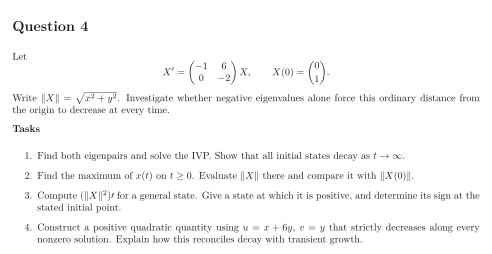
Step 2: Exhibit transient amplification. The derivative changes from positive to negative at . Thus , while there. Consequently This is the maximum of , not a claim about the time of maximum norm.
Step 3: Test instantaneous norm growth. Direct differentiation gives At it equals , so the norm can increase. At the given initial state it equals : this trajectory first moves closer, but later exceeds its initial distance. Negative eigenvalues do not make this quadratic expression negative at every state.
Step 4: Use a norm adapted to the modes. The invertible coordinates satisfy , . Thus is positive except at zero and for every nonzero state. The Euclidean circles and the level ellipses of measure different sizes. Decrease of the latter is compatible with temporary Euclidean growth, and the explicit modes still establish eventual decay.
See the diagram in the original worksheet below.