Question 3
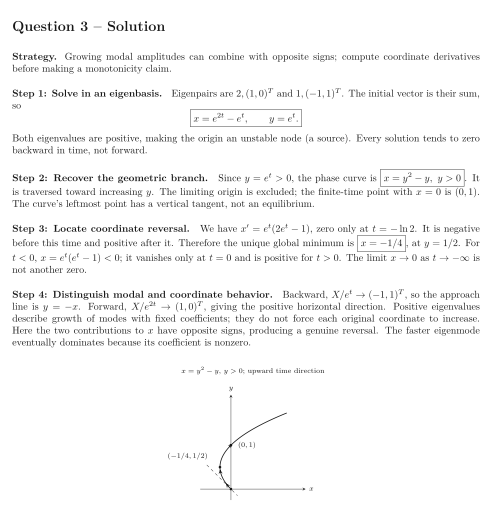
For a student claims that positive eigenvalues force both coordinates to increase for all real time. Investigate the entire trajectory, including .
Tasks
Find the eigenpairs and the solution, and classify the equilibrium.
Eliminate time to find the exact phase curve and its domain. Determine its time direction.
Find every stationary point of and classify it. Determine when is negative and when it vanishes.
Identify the limiting eigenline as and the limiting direction as . Explain what is wrong with the student’s claim.
Show solutionHide solution
Question 3 – Solution
Strategy. Growing modal amplitudes can combine with opposite signs; compute coordinate derivatives before making a monotonicity claim.
Step 1: Solve in an eigenbasis. Eigenpairs are and . The initial vector is their sum, so Both eigenvalues are positive, making the origin an unstable node (a source). Every solution tends to zero backward in time, not forward.
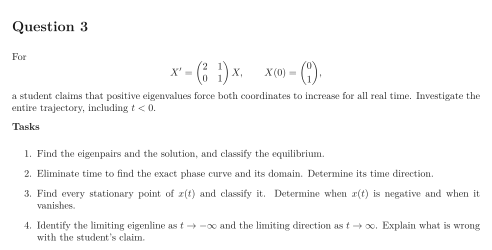
Step 2: Recover the geometric branch. Since , the phase curve is . It is traversed toward increasing . The limiting origin is excluded; the finite-time point with is . The curve’s leftmost point has a vertical tangent, not an equilibrium.
Step 3: Locate coordinate reversal. We have , zero only at . It is negative before this time and positive after it. Therefore the unique global minimum is , at . For , ; it vanishes only at and is positive for . The limit as is not another zero.
Step 4: Distinguish modal and coordinate behavior. Backward, , so the approach line is . Forward, , giving the positive horizontal direction. Positive eigenvalues describe growth of modes with fixed coefficients; they do not force each original coordinate to increase. Here the two contributions to have opposite signs, producing a genuine reversal. The faster eigenmode eventually dominates because its coefficient is nonzero.
See the diagram in the original worksheet below.