Question 6
For , , consider You may use uniqueness of linear initial-value problems with continuous coefficients. The independent variable is real time.
Tasks
Verify both solutions and state their initial vectors.
Find all real times when their first components agree. At those times compare their second components and decide whether the full states coincide.
Prove that two solutions of the same continuous linear system agreeing in their full state at one time must agree throughout their common interval. Apply this to the zero solution of a homogeneous system.
Find a constant time shift relating to . Explain why identical states at different times are compatible with your uniqueness statement.
Show solutionHide solution
Question 6 – Solution
Strategy. Keep equality of one coordinate, equality of full states at the same time, and a time-shift relation separate.
Step 1: Verify the two vector equations. Differentiation gives and . Their initial vectors are and .
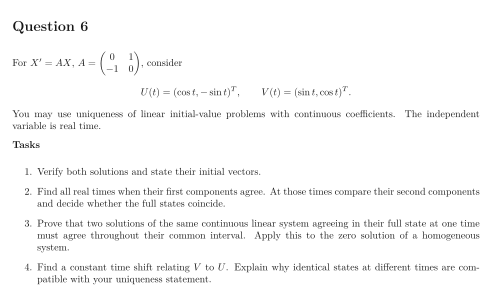
Step 2: Find the coordinate coincidences. The equation holds exactly at At such a time the common first component is . The second components are its negative for and its positive for , so they differ. More generally, The full states never agree at the same time. The figure displays first components only, and marks one coordinate coincidence.
Step 3: State what uniqueness actually implies. Suppose two solutions share the full vector . They solve the same IVP at , so uniqueness makes them identical on their common interval. Equivalently their difference solves the homogeneous equation with zero initial data and must vanish throughout that interval. Taking one solution to be zero proves that a homogeneous solution reaching the full zero state cannot later depart from it.
Step 4: Check the shifted identity. Trigonometric identities give . This compares states at different time arguments; it does not assert . An autonomous system permits translating a solution in time, and the shifted function normally has different initial data at time . Thus the shift creates no conflict with same-time IVP uniqueness.
See the diagram in the original worksheet below.