Question 4
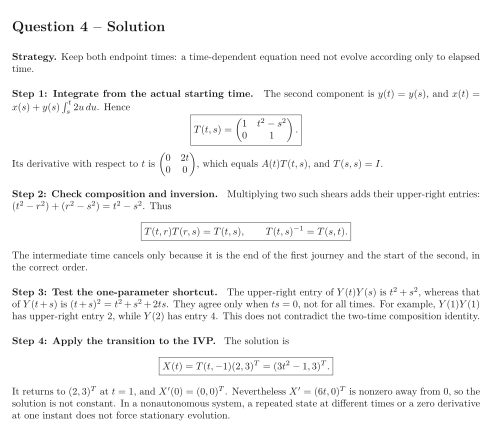
For the nonautonomous system define the transition matrix by for arbitrary real starting time . It must satisfy .
Tasks
Derive from the component equations and verify its differential equation and normalization.
Prove and determine the inverse of . Explain the role of the intermediate time.
Let . Determine whether holds for all real , and give a concrete counterexample if it fails.
Solve the IVP . Compare with and compute . Does either equality imply that the solution is constant?
Show solutionHide solution
Question 4 – Solution
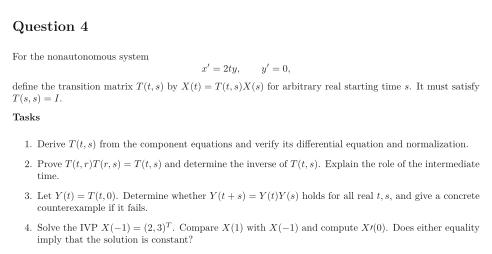
Strategy. Keep both endpoint times: a time-dependent equation need not evolve according only to elapsed time.
Step 1: Integrate from the actual starting time. The second component is , and . Hence Its derivative with respect to is , which equals , and .
Step 2: Check composition and inversion. Multiplying two such shears adds their upper-right entries: . Thus The intermediate time cancels only because it is the end of the first journey and the start of the second, in the correct order.
Step 3: Test the one-parameter shortcut. The upper-right entry of is , whereas that of is . They agree only when , not for all times. For example, has upper-right entry , while has entry . This does not contradict the two-time composition identity.
Step 4: Apply the transition to the IVP. The solution is It returns to at , and . Nevertheless is nonzero away from , so the solution is not constant. In a nonautonomous system, a repeated state at different times or a zero derivative at one instant does not force stationary evolution.