Question 8
An eigenpair satisfies with . The eigenspace includes zero, although zero is not an eigenvector. Algebraic multiplicity counts roots of ; geometric multiplicity is . Work over unless complex scalars are explicitly requested.
For real , consider Investigate diagonalization over both and .
Tasks
Find the characteristic polynomial and classify its roots for , and . Check trace and determinant against the roots.
Find every eigenspace and classify diagonalizability in both fields, including the repeated-root case.
For , write a complex eigenvector as and construct a real basis in which has a real block representing its complex pair.
As , examine a real eigenvector basis and its inverse. Explain why the limiting matrix can fail to be diagonalizable even though every matrix before the limit is diagonalizable.
Show solutionHide solution
Question 8 – Solution
Strategy. Follow the eigenvectors as well as the roots. Distinct roots can merge into one direction at the transition.
Step 1: Classify the roots. The polynomial is . For , set ; the roots are . At the root is twice. For , set ; the roots are . Their sum is and product is in all cases.
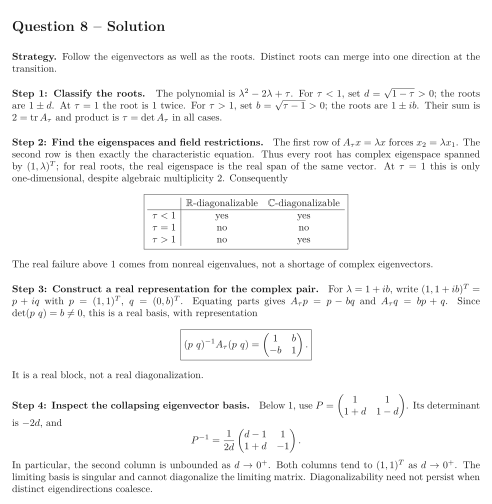
Step 2: Find the eigenspaces and field restrictions. The first row of forces . The second row is then exactly the characteristic equation. Thus every root has complex eigenspace spanned by ; for real roots, the real eigenspace is the real span of the same vector. At this is only one-dimensional, despite algebraic multiplicity . Consequently The real failure above comes from nonreal eigenvalues, not a shortage of complex eigenvectors.
Step 3: Construct a real representation for the complex pair. For , write with , . Equating parts gives and . Since , this is a real basis, with representation It is a real block, not a real diagonalization.
Step 4: Inspect the collapsing eigenvector basis. Below , use . Its determinant is , and In particular, the second column is unbounded as . Both columns tend to as . The limiting basis is singular and cannot diagonalize the limiting matrix. Diagonalizability need not persist when distinct eigendirections coalesce.