Question 10
Work with real matrices and column vectors. Write for the identity, for transpose, and for Euclidean length. Show the reasoning behind every classification; do not use eigenvalue methods.
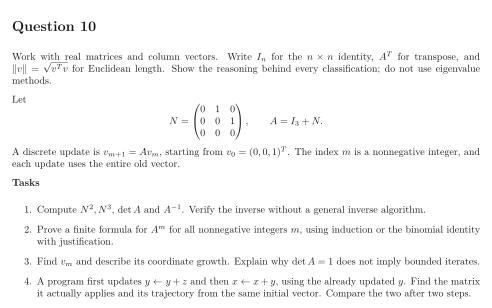
Let A discrete update is , starting from . The index is a nonnegative integer, and each update uses the entire old vector.
Tasks
Compute , and . Verify the inverse without a general inverse algorithm.
Prove a finite formula for for all nonnegative integers , using induction or the binomial identity with justification.
Find and describe its coordinate growth. Explain why does not imply bounded iterates.
A program first updates and then , using the already updated . Find the matrix it actually applies and its trajectory from the same initial vector. Compare the two after two steps.
Show solutionHide solution
Question 10 – Solution
Strategy. The powers of the strictly upper triangular part terminate. A matrix update is simultaneous unless a different order is explicitly encoded.
Step 1: Exploit the terminating powers. Multiplication gives and . The upper triangular matrix has determinant . Moreover because ; the reverse product is the same.
Step 2: Derive the finite power formula. The identity matrix commutes with , so the binomial expansion terminates: Alternatively, the formula is true at . Multiplication by increases the coefficient of to and that of to , establishing the induction step.
Step 3: Find the exact iterates. Applying the power formula to gives The first coordinate grows quadratically, the second linearly and the third stays fixed. Determinant preserves oriented volumes of three-dimensional sets, not individual lengths or boundedness under repetition. The plot marks integer-time values only; coincident coordinate values share a location.
Step 4: Diagnose the sequential-update error. The program computes and then . It actually applies Starting from , its third coordinate remains , its second becomes , and its first accumulates . After two steps the correct vector is , while the program gives . Both matrices are invertible with determinant , so checking only the determinant would not expose this order-of-update mistake.
See the diagram in the original worksheet below.
