Question 6
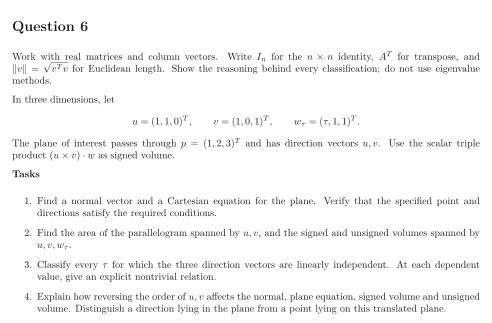
Work with real matrices and column vectors. Write for the identity, for transpose, and for Euclidean length. Show the reasoning behind every classification; do not use eigenvalue methods.
In three dimensions, let The plane of interest passes through and has direction vectors . Use the scalar triple product as signed volume.
Tasks
Find a normal vector and a Cartesian equation for the plane. Verify that the specified point and directions satisfy the required conditions.
Find the area of the parallelogram spanned by , and the signed and unsigned volumes spanned by .
Classify every for which the three direction vectors are linearly independent. At each dependent value, give an explicit nontrivial relation.
Explain how reversing the order of affects the normal, plane equation, signed volume and unsigned volume. Distinguish a direction lying in the plane from a point lying on this translated plane.
Show solutionHide solution
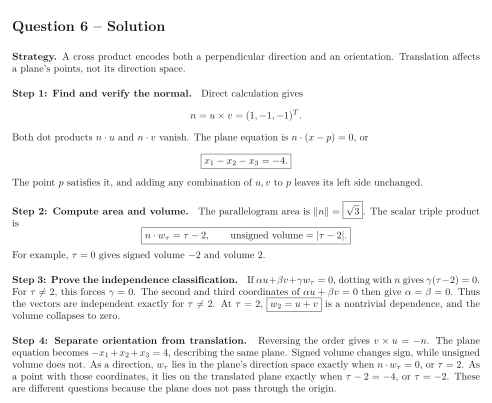
Question 6 – Solution
Strategy. A cross product encodes both a perpendicular direction and an orientation. Translation affects a plane’s points, not its direction space.
Step 1: Find and verify the normal. Direct calculation gives Both dot products and vanish. The plane equation is , or The point satisfies it, and adding any combination of to leaves its left side unchanged.
Step 2: Compute area and volume. The parallelogram area is . The scalar triple product is For example, gives signed volume and volume .
Step 3: Prove the independence classification. If , dotting with gives . For , this forces . The second and third coordinates of then give . Thus the vectors are independent exactly for . At , is a nontrivial dependence, and the volume collapses to zero.
Step 4: Separate orientation from translation. Reversing the order gives . The plane equation becomes , describing the same plane. Signed volume changes sign, while unsigned volume does not. As a direction, lies in the plane’s direction space exactly when , or . As a point with those coordinates, it lies on the translated plane exactly when , or . These are different questions because the plane does not pass through the origin.