Question 1
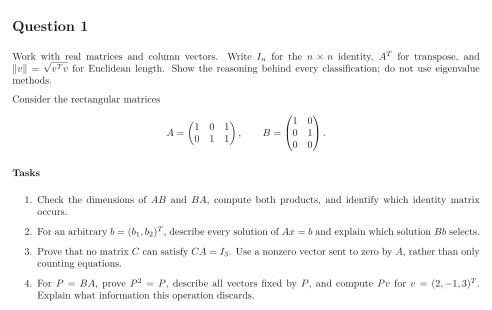
Work with real matrices and column vectors. Write for the identity, for transpose, and for Euclidean length. Show the reasoning behind every classification; do not use eigenvalue methods.
Consider the rectangular matrices
Tasks
Check the dimensions of and , compute both products, and identify which identity matrix occurs.
For an arbitrary , describe every solution of and explain which solution selects.
Prove that no matrix can satisfy . Use a nonzero vector sent to zero by , rather than only counting equations.
For , prove , describe all vectors fixed by , and compute for . Explain what information this operation discards.
Show solutionHide solution
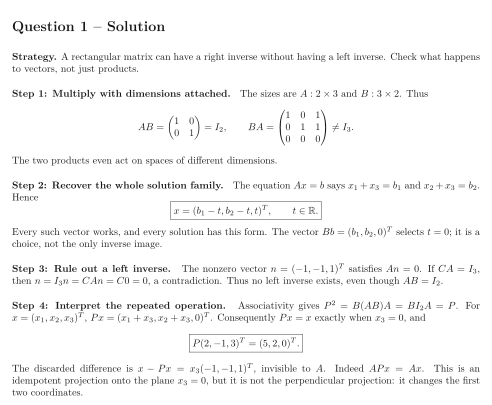
Question 1 – Solution
Strategy. A rectangular matrix can have a right inverse without having a left inverse. Check what happens to vectors, not just products.
Step 1: Multiply with dimensions attached. The sizes are and . Thus The two products even act on spaces of different dimensions.
Step 2: Recover the whole solution family. The equation says and . Hence Every such vector works, and every solution has this form. The vector selects ; it is a choice, not the only inverse image.
Step 3: Rule out a left inverse. The nonzero vector satisfies . If , then , a contradiction. Thus no left inverse exists, even though .
Step 4: Interpret the repeated operation. Associativity gives . For , . Consequently exactly when , and The discarded difference is , invisible to . Indeed . This is an idempotent projection onto the plane , but it is not the perpendicular projection: it changes the first two coordinates.