Question 9
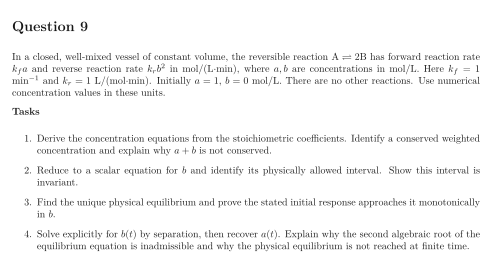
In a closed, well-mixed vessel of constant volume, the reversible reaction has forward reaction rate and reverse reaction rate in mol/(Lmin), where are concentrations in mol/L. Here min and L/(molmin). Initially , mol/L. There are no other reactions. Use numerical concentration values in these units.
Tasks
Derive the concentration equations from the stoichiometric coefficients. Identify a conserved weighted concentration and explain why is not conserved.
Reduce to a scalar equation for and identify its physically allowed interval. Show this interval is invariant.
Find the unique physical equilibrium and prove the stated initial response approaches it monotonically in .
Solve explicitly for by separation, then recover . Explain why the second algebraic root of the equilibrium equation is inadmissible and why the physical equilibrium is not reached at finite time.
Show solutionHide solution
Question 9 – Solution
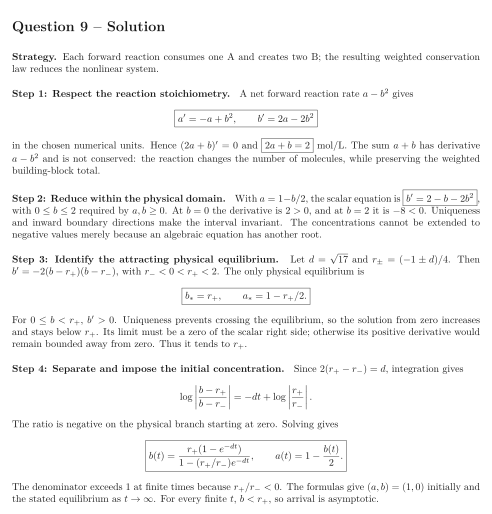
Strategy. Each forward reaction consumes one A and creates two B; the resulting weighted conservation law reduces the nonlinear system.
Step 1: Respect the reaction stoichiometry. A net forward reaction rate gives in the chosen numerical units. Hence and mol/L. The sum has derivative and is not conserved: the reaction changes the number of molecules, while preserving the weighted building-block total.
Step 2: Reduce within the physical domain. With , the scalar equation is , with required by . At the derivative is , and at it is . Uniqueness and inward boundary directions make the interval invariant. The concentrations cannot be extended to negative values merely because an algebraic equation has another root.
Step 3: Identify the attracting physical equilibrium. Let and . Then , with . The only physical equilibrium is For , . Uniqueness prevents crossing the equilibrium, so the solution from zero increases and stays below . Its limit must be a zero of the scalar right side; otherwise its positive derivative would remain bounded away from zero. Thus it tends to .
Step 4: Separate and impose the initial concentration. Since , integration gives The ratio is negative on the physical branch starting at zero. Solving gives The denominator exceeds at finite times because . The formulas give initially and the stated equilibrium as . For every finite , , so arrival is asymptotic.