Question 4
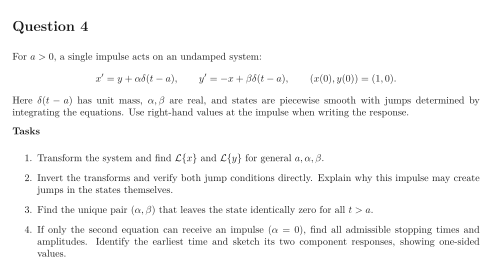
For , a single impulse acts on an undamped system: Here has unit mass, are real, and states are piecewise smooth with jumps determined by integrating the equations. Use right-hand values at the impulse when writing the response.
Tasks
Transform the system and find and for general .
Invert the transforms and verify both jump conditions directly. Explain why this impulse may create jumps in the states themselves.
Find the unique pair that leaves the state identically zero for all .
If only the second equation can receive an impulse (), find all admissible stopping times and amplitudes. Identify the earliest time and sketch its two component responses, showing one-sided values.
Show solutionHide solution
Question 4 – Solution
Strategy. The shifted impulse produces a shifted homogeneous response; stopping requires cancellation of the complete pre-impulse state.
Step 1: Solve in the transform domain. The equations are and . Thus, for , This half-plane suffices for all parameter choices, even when cancellation makes the actual response have compact support.
Step 2: Invert and check jumps. For , . For , with , Hence , where . Integrating the original equations across gives these same jumps: the ordinary bounded terms contribute zero in the shrinking interval, while the impulses contribute their masses. Away from the ordinary equations hold.
Step 3: Cancel the full state. The state just before is . The only kick making the right-hand state zero is . The ensuing homogeneous IVP then stays zero by uniqueness. Conversely, an identically zero future requires that same right-hand state, so the kick is unique.
Step 4: Restrict the available impulse. With , cancellation requires . Thus . The earliest is , . There is continuous at zero, while jumps from to . Both vanish afterward. The vertical dotted segment marks a jump, not values traversed continuously by the solution.
See the diagram in the original worksheet below.
