Question 3
All functions are causal (zero for ). Use the one-sided Laplace transform and . Write for and for . Values at isolated endpoints do not affect an ordinary integral.
An undamped oscillator receives a rapidly vanishing force: You may leave Gaussian integrals unevaluated and use .
Tasks
Find in terms of and write a convolution formula for .
Verify the equation and both initial conditions by differentiating your convolution.
Find a limiting sinusoidal expression with constant coefficients and prove for .
Prove that the response does not tend to zero, despite the vanishing force. Identify which feature of the homogeneous equation makes this possible.
Show solutionHide solution
Question 3 – Solution
Strategy. Keep the Gaussian force inside an integral and separate the permanent oscillation from the remaining tail integral.
Step 1: Transform and invert. The initial terms give , hence These transform operations are valid for real .
Step 2: Differentiate with the endpoint terms. The sine kernel vanishes at its endpoint, so . Differentiating again gives because . Also . Thus the formula satisfies the full IVP.
Step 3: Isolate the asymptotic oscillation. Set and , both absolutely convergent. Expanding gives For , use on the tail:
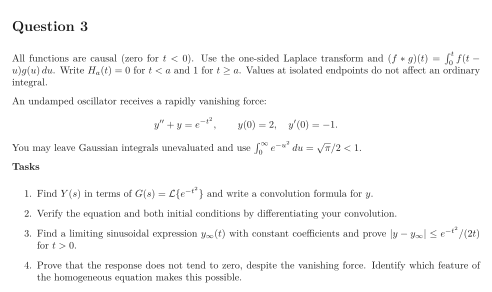
Step 4: Establish persistent motion. Since , the coefficient is nonzero. The limiting sinusoid therefore has positive amplitude and has recurring positive and negative extrema. Along their times the error tends to zero, so cannot tend to zero (or to any single constant). The homogeneous modes have no damping. The figure compares the exact integral solution with ; the two quickly become indistinguishable.
See the diagram in the original worksheet below.