Question 4
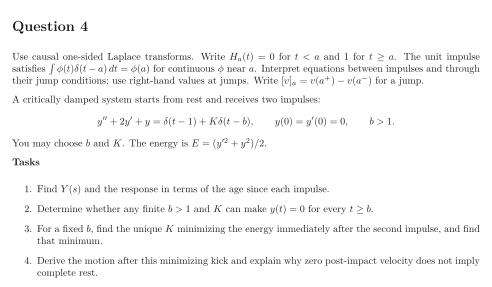
Use causal one-sided Laplace transforms. Write for and for . The unit impulse satisfies for continuous near . Interpret equations between impulses and through their jump conditions; use right-hand values at jumps. Write for a jump.
A critically damped system starts from rest and receives two impulses: You may choose and . The energy is .
Tasks
Find and the response in terms of the age since each impulse.
Determine whether any finite and can make for every .
For a fixed , find the unique minimizing the energy immediately after the second impulse, and find that minimum.
Derive the motion after this minimizing kick and explain why zero post-impact velocity does not imply complete rest.
Show solutionHide solution
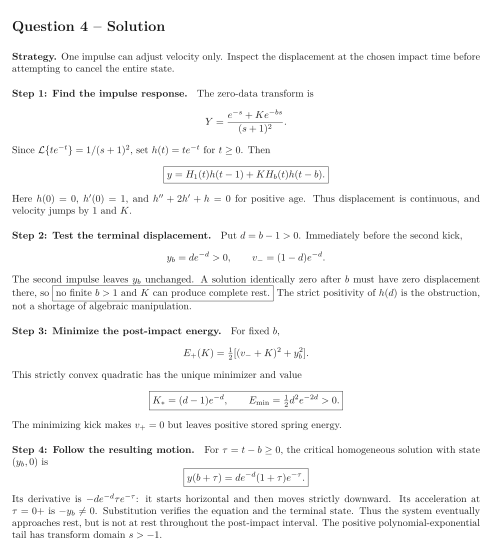
Question 4 – Solution
Strategy. One impulse can adjust velocity only. Inspect the displacement at the chosen impact time before attempting to cancel the entire state.
Step 1: Find the impulse response. The zero-data transform is Since , set for . Then Here , , and for positive age. Thus displacement is continuous, and velocity jumps by and .
Step 2: Test the terminal displacement. Put . Immediately before the second kick, The second impulse leaves unchanged. A solution identically zero after must have zero displacement there, so The strict positivity of is the obstruction, not a shortage of algebraic manipulation.
Step 3: Minimize the post-impact energy. For fixed , This strictly convex quadratic has the unique minimizer and value The minimizing kick makes but leaves positive stored spring energy.
Step 4: Follow the resulting motion. For , the critical homogeneous solution with state is Its derivative is : it starts horizontal and then moves strictly downward. Its acceleration at is . Substitution verifies the equation and the terminal state. Thus the system eventually approaches rest, but is not at rest throughout the post-impact interval. The positive polynomial-exponential tail has transform domain .