Question 8
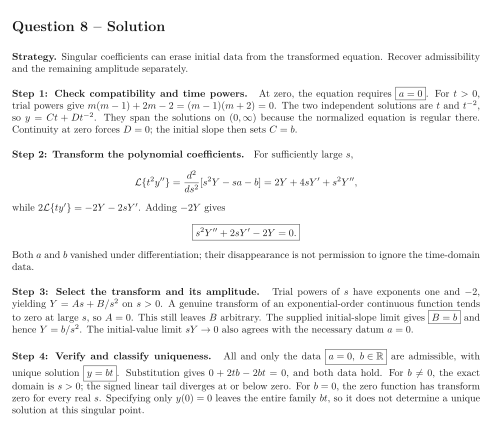
Use ordinary one-sided Laplace integrals for real . Where justified, write and use . Check existence and initial compatibility before treating a formal solution in as a transform.
Classify the data for which a twice continuously differentiable solution on can satisfy For a smooth exponential-order function with , you may use .
Tasks
Find the compatibility condition at zero and solve the time equation for using trial powers .
Derive the second-order differential equation for , accounting for the effect of two parameter derivatives on the initial terms.
Solve the transformed equation using trial powers . Determine what the condition fixes and what initial information is still needed.
Classify all admissible pairs , verify the resulting solutions, and state their exact transform domains. Is specifying only enough for uniqueness?
Show solutionHide solution
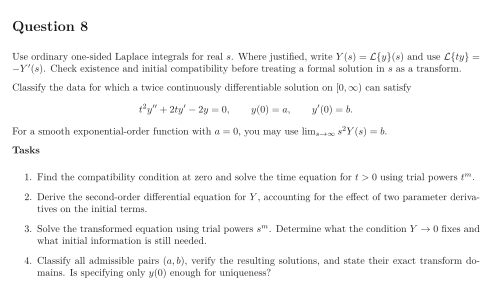
Question 8 – Solution
Strategy. Singular coefficients can erase initial data from the transformed equation. Recover admissibility and the remaining amplitude separately.
Step 1: Check compatibility and time powers. At zero, the equation requires . For , trial powers give . The two independent solutions are and , so . They span the solutions on because the normalized equation is regular there. Continuity at zero forces ; the initial slope then sets .
Step 2: Transform the polynomial coefficients. For sufficiently large , while . Adding gives Both and vanished under differentiation; their disappearance is not permission to ignore the time-domain data.
Step 3: Select the transform and its amplitude. Trial powers of have exponents one and , yielding on . A genuine transform of an exponential-order continuous function tends to zero at large , so . This still leaves arbitrary. The supplied initial-slope limit gives and hence . The initial-value limit also agrees with the necessary datum .
Step 4: Verify and classify uniqueness. All and only the data are admissible, with unique solution . Substitution gives , and both data hold. For , the exact domain is ; the signed linear tail diverges at or below zero. For , the zero function has transform zero for every real . Specifying only leaves the entire family , so it does not determine a unique solution at this singular point.