Question 3
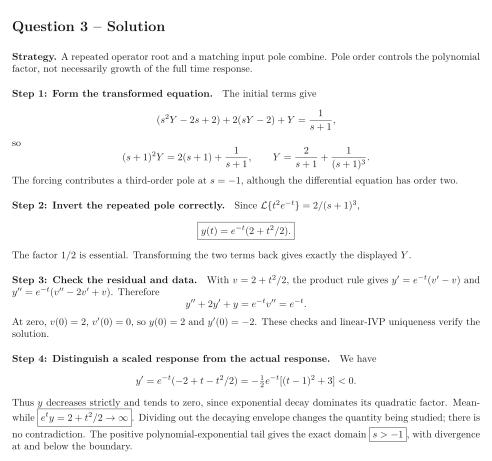
Use one-sided Laplace transforms and retain all initial-value terms. Write , with real sufficiently large during the transformation. Unless stated otherwise, solve on .
Consider a repeated-root operator with matching exponential forcing:
Tasks
Find and identify the order of the pole produced by the forcing.
Invert , keeping the factorial normalization of the repeated pole.
Verify the equation and both initial data directly. You may simplify the residual by setting .
Determine whether decreases to zero and whether stays bounded. Explain why these conclusions are compatible and state the transform domain.
Show solutionHide solution
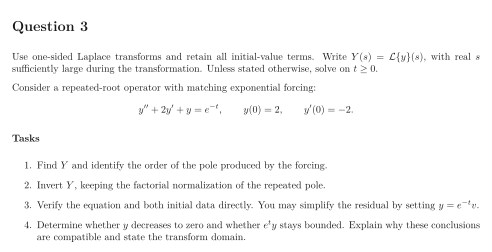
Question 3 – Solution
Strategy. A repeated operator root and a matching input pole combine. Pole order controls the polynomial factor, not necessarily growth of the full time response.
Step 1: Form the transformed equation. The initial terms give so The forcing contributes a third-order pole at , although the differential equation has order two.
Step 2: Invert the repeated pole correctly. Since , The factor is essential. Transforming the two terms back gives exactly the displayed .
Step 3: Check the residual and data. With , the product rule gives and . Therefore At zero, , , so and . These checks and linear-IVP uniqueness verify the solution.
Step 4: Distinguish a scaled response from the actual response. We have Thus decreases strictly and tends to zero, since exponential decay dominates its quadratic factor. Meanwhile . Dividing out the decaying envelope changes the quantity being studied; there is no contradiction. The positive polynomial-exponential tail gives the exact domain , with divergence at and below the boundary.