Question 9
Use causal one-sided Laplace transforms. Write for and for . Ordinary functions are zero for . Justify the table entries and operational rules you use; give exact expressions.
A measured response is known to lie in the three-mode family The available data are , and .
Tasks
Recover the three coefficients and prove uniqueness within the stated family.
Construct by table lookup and simplify it to one rational expression. Check its leading large- term against the data.
Prove that the recovered function is positive for every despite a negative coefficient. Find its unique global maximum.
Compute its area and exact real transform domain. Explain why the three measurements would not identify a unique response without the three-mode assumption.
Show solutionHide solution
Question 9 – Solution
Strategy. The assumed modes turn derivative data into a finite linear system. A negative coefficient need not make their sum negative.
Step 1: Solve and prove uniqueness. The data give Adding the first two equations gives , and the first then gives . Substitution into the third gives . Every coefficient is forced, proving uniqueness: .
Step 2: Assemble the rational transform. The table yields Near zero, , so its leading transform is , matching the quotient. The and terms cancel exactly.
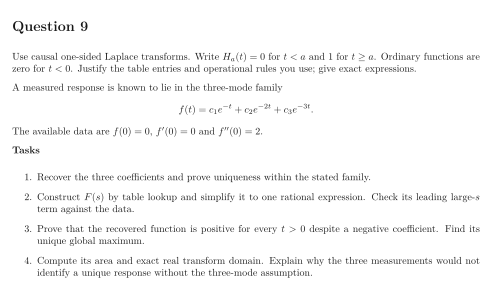
Step 3: Establish positivity and the peak. Factor the function as . It is positive for every and zero at . Put . The function has derivative with respect to ; along increasing its unique interior maximum is at . Therefore
Step 4: Check area, domain and identifiability. The area is . The nonzero tail gives exact real domain . Without the mode restriction, adding any multiple of would preserve all three measured derivatives but change the response. Thus the identification is unique within the stated model, not among all smooth functions.
See the diagram in the original worksheet below.