Question 4
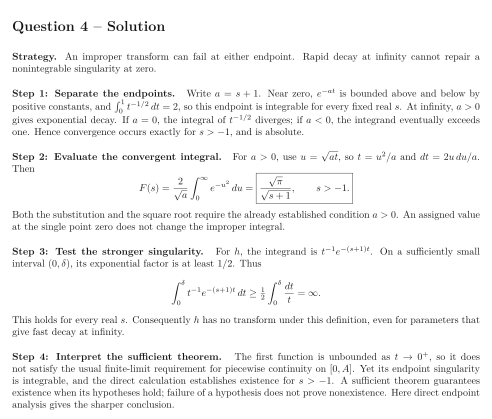
For real , use whenever this ordinary improper integral converges.
For , let ; assign any finite value to . For the defining integral, treat zero as an improper endpoint as well as infinity. You may use .
Tasks
Analyze convergence near zero and near infinity separately, and find the exact real convergence set.
Evaluate on that set by a substitution.
Repeat the endpoint analysis for , . Does exponential decay guarantee a transform for this function?
Explain why the first example does not contradict a theorem giving piecewise continuity on each finite interval and exponential order as sufficient conditions for existence.
Show solutionHide solution
Question 4 – Solution
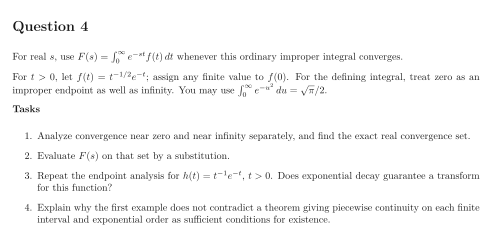
Strategy. An improper transform can fail at either endpoint. Rapid decay at infinity cannot repair a nonintegrable singularity at zero.
Step 1: Separate the endpoints. Write . Near zero, is bounded above and below by positive constants, and , so this endpoint is integrable for every fixed real . At infinity, gives exponential decay. If , the integral of diverges; if , the integrand eventually exceeds one. Hence convergence occurs exactly for , and is absolute.
Step 2: Evaluate the convergent integral. For , use , so and . Then Both the substitution and the square root require the already established condition . An assigned value at the single point zero does not change the improper integral.
Step 3: Test the stronger singularity. For , the integrand is . On a sufficiently small interval , its exponential factor is at least . Thus This holds for every real . Consequently has no transform under this definition, even for parameters that give fast decay at infinity.
Step 4: Interpret the sufficient theorem. The first function is unbounded as , so it does not satisfy the usual finite-limit requirement for piecewise continuity on . Yet its endpoint singularity is integrable, and the direct calculation establishes existence for . A sufficient theorem guarantees existence when its hypotheses hold; failure of a hypothesis does not prove nonexistence. Here direct endpoint analysis gives the sharper conclusion.