Question 10
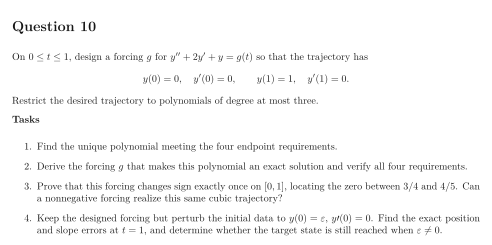
On , design a forcing for so that the trajectory has Restrict the desired trajectory to polynomials of degree at most three.
Tasks
Find the unique polynomial meeting the four endpoint requirements.
Derive the forcing that makes this polynomial an exact solution and verify all four requirements.
Prove that this forcing changes sign exactly once on , locating the zero between and . Can a nonnegative forcing realize this same cubic trajectory?
Keep the designed forcing but perturb the initial data to , . Find the exact position and slope errors at , and determine whether the target state is still reached when .
Show solutionHide solution
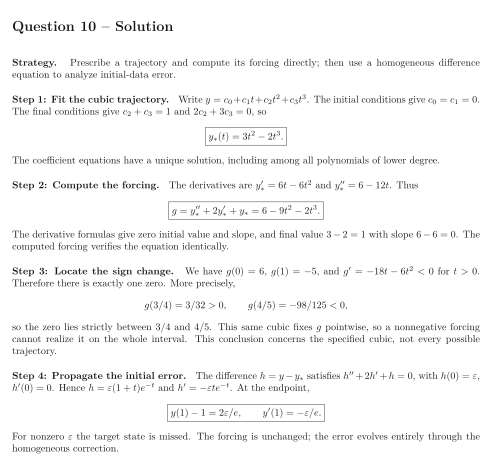
Question 10 – Solution
Strategy. Prescribe a trajectory and compute its forcing directly; then use a homogeneous difference equation to analyze initial-data error.
Step 1: Fit the cubic trajectory. Write . The initial conditions give . The final conditions give and , so The coefficient equations have a unique solution, including among all polynomials of lower degree.
Step 2: Compute the forcing. The derivatives are and . Thus The derivative formulas give zero initial value and slope, and final value with slope . The computed forcing verifies the equation identically.
Step 3: Locate the sign change. We have , , and for . Therefore there is exactly one zero. More precisely, so the zero lies strictly between and . This same cubic fixes pointwise, so a nonnegative forcing cannot realize it on the whole interval. This conclusion concerns the specified cubic, not every possible trajectory.
Step 4: Propagate the initial error. The difference satisfies , with , . Hence and . At the endpoint, For nonzero the target state is missed. The forcing is unchanged; the error evolves entirely through the homogeneous correction.