Question 1
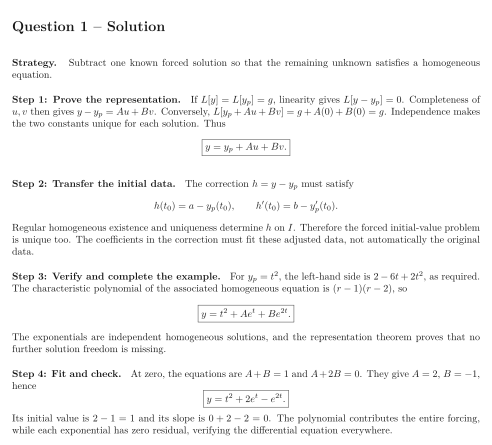
Let on a connected open interval , where are continuous. Suppose is one solution of , and form a fundamental set for .
Tasks
Prove that every solution of has the form , with unique constants . Prove both directions.
If initial data , are prescribed, state the initial data that the homogeneous correction must satisfy and explain uniqueness.
For on , verify the supplied particular solution and find the general solution.
Solve the example with , , verifying the equation and initial data.
Show solutionHide solution
Question 1 – Solution
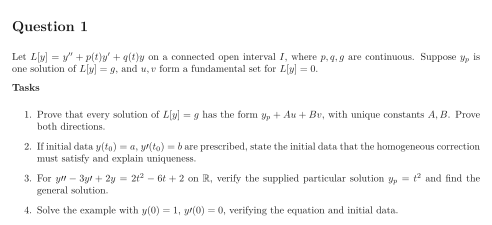
Strategy. Subtract one known forced solution so that the remaining unknown satisfies a homogeneous equation.
Step 1: Prove the representation. If , linearity gives . Completeness of then gives . Conversely, . Independence makes the two constants unique for each solution. Thus
Step 2: Transfer the initial data. The correction must satisfy Regular homogeneous existence and uniqueness determine on . Therefore the forced initial-value problem is unique too. The coefficients in the correction must fit these adjusted data, not automatically the original data.
Step 3: Verify and complete the example. For , the left-hand side is , as required. The characteristic polynomial of the associated homogeneous equation is , so The exponentials are independent homogeneous solutions, and the representation theorem proves that no further solution freedom is missing.
Step 4: Fit and check. At zero, the equations are and . They give , , hence Its initial value is and its slope is . The polynomial contributes the entire forcing, while each exponential has zero residual, verifying the differential equation everywhere.