Question 8
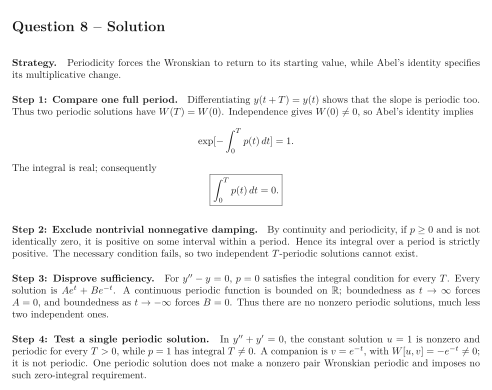
Suppose are real continuous functions on , each periodic with period . Consider . A -periodic solution satisfies for every real .
Tasks
Prove that the existence of two independent -periodic solutions requires .
If and is not identically zero, decide whether two such periodic solutions can exist.
Is the zero-integral condition sufficient? Analyze as a counterexample and justify the absence of nonzero periodic solutions.
Does the existence of just one nonzero -periodic solution force the same integral condition? Analyze and identify a nonperiodic companion.
Show solutionHide solution
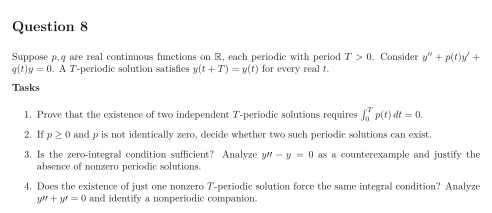
Question 8 – Solution
Strategy. Periodicity forces the Wronskian to return to its starting value, while Abel’s identity specifies its multiplicative change.
Step 1: Compare one full period. Differentiating shows that the slope is periodic too. Thus two periodic solutions have . Independence gives , so Abel’s identity implies The integral is real; consequently
Step 2: Exclude nontrivial nonnegative damping. By continuity and periodicity, if and is not identically zero, it is positive on some interval within a period. Hence its integral over a period is strictly positive. The necessary condition fails, so two independent -periodic solutions cannot exist.
Step 3: Disprove sufficiency. For , satisfies the integral condition for every . Every solution is . A continuous periodic function is bounded on ; boundedness as forces , and boundedness as forces . Thus there are no nonzero periodic solutions, much less two independent ones.
Step 4: Test a single periodic solution. In , the constant solution is nonzero and periodic for every , while has integral . A companion is , with ; it is not periodic. One periodic solution does not make a nonzero pair Wronskian periodic and imposes no such zero-integral requirement.