Question 10
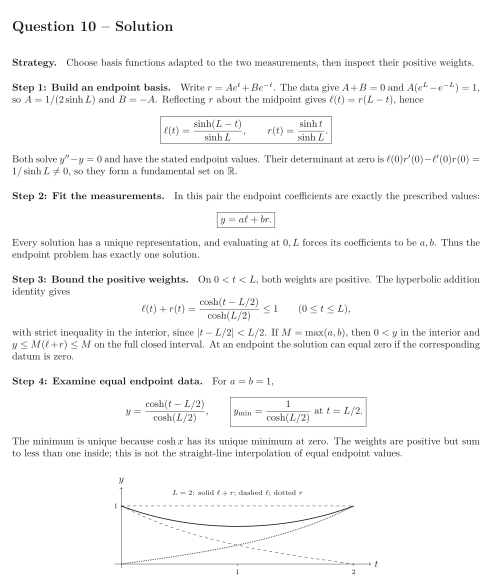
For on , fix . Seek solutions with endpoint values Use and .
Tasks
Construct from the exponential fundamental pair and prove that they also form a fundamental set.
Use this pair to solve , for arbitrary real . Prove uniqueness.
For and not both zero, prove positivity on and on . Determine whether in the interior.
For , locate the unique minimum on and give its value. Explain why positive interpolation weights do not imply straight-line interpolation.
Show solutionHide solution
Question 10 – Solution
Strategy. Choose basis functions adapted to the two measurements, then inspect their positive weights.
Step 1: Build an endpoint basis. Write . The data give and , so and . Reflecting about the midpoint gives , hence Both solve and have the stated endpoint values. Their determinant at zero is , so they form a fundamental set on .
Step 2: Fit the measurements. In this pair the endpoint coefficients are exactly the prescribed values: Every solution has a unique representation, and evaluating at forces its coefficients to be . Thus the endpoint problem has exactly one solution.
Step 3: Bound the positive weights. On , both weights are positive. The hyperbolic addition identity gives with strict inequality in the interior, since . If , then in the interior and on the full closed interval. At an endpoint the solution can equal zero if the corresponding datum is zero.
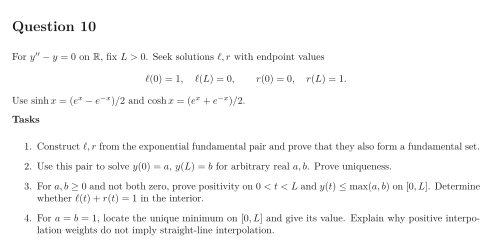
Step 4: Examine equal endpoint data. For , The minimum is unique because has its unique minimum at zero. The weights are positive but sum to less than one inside; this is not the straight-line interpolation of equal endpoint values.
See the diagram in the original worksheet below.