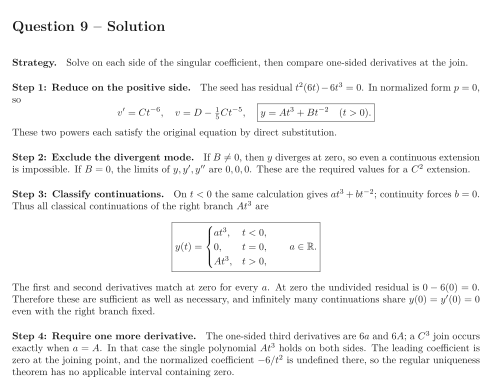
Question 9
Consider the original undivided equation . First work on with known solution . A classical solution through zero means a function satisfying the undivided equation on an open interval containing zero.
Tasks
Use reduction of order to find every solution on .
Which right-hand solutions admit a extension through zero? Find the forced value, slope and second derivative at zero.
For each admissible right-hand solution, classify all classical continuations to . Explain whether the zero initial data determine a unique continuation.
Which of those continuations are at zero? Explain why the usual uniqueness theorem does not settle this problem.
Show solutionHide solution
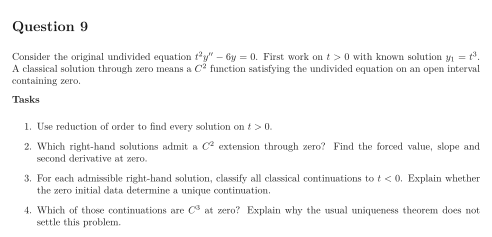
Question 9 – Solution
Strategy. Solve on each side of the singular coefficient, then compare one-sided derivatives at the join.
Step 1: Reduce on the positive side. The seed has residual . In normalized form , so These two powers each satisfy the original equation by direct substitution.
Step 2: Exclude the divergent mode. If , then diverges at zero, so even a continuous extension is impossible. If , the limits of are . These are the required values for a extension.
Step 3: Classify continuations. On the same calculation gives ; continuity forces . Thus all classical continuations of the right branch are The first and second derivatives match at zero for every . At zero the undivided residual is . Therefore these are sufficient as well as necessary, and infinitely many continuations share even with the right branch fixed.
Step 4: Require one more derivative. The one-sided third derivatives are and ; a join occurs exactly when . In that case the single polynomial holds on both sides. The leading coefficient is zero at the joining point, and the normalized coefficient is undefined there, so the regular uniqueness theorem has no applicable interval containing zero.