Question 7
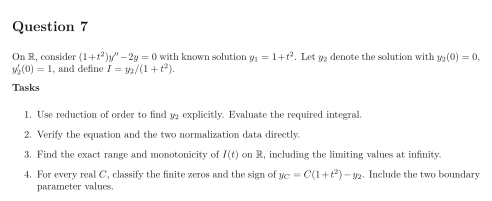
On , consider with known solution . Let denote the solution with , , and define .
Tasks
Use reduction of order to find explicitly. Evaluate the required integral.
Verify the equation and the two normalization data directly.
Find the exact range and monotonicity of on , including the limiting values at infinity.
For every real , classify the finite zeros and the sign of . Include the two boundary parameter values.
Show solutionHide solution
Question 7 – Solution
Strategy. Divide the solution family by its positive seed so that zeros become level crossings of a monotone function.
Step 1: Construct the companion. The seed residual is . Since , The integral follows by setting and integrating . Hence
Step 2: Verify. We obtain and . The equation holds and the data are .
Step 3: Determine the ratio range. Since , the ratio is strictly increasing. Its limits are and ; neither is attained. Its range is exactly by continuity.
Step 4: Classify all parameters. The sign of is the sign of . If , there is exactly one finite zero, with positive values before it and negative values after it. If , the solution is strictly positive everywhere; if , it is strictly negative everywhere. Equality in these last two cases does not create a finite zero because the limiting ratio levels are excluded.
See the diagram in the original worksheet below.
