Question 3
Consider the equation on with known solution . An integral is an acceptable exact answer.
Tasks
Verify the seed and derive the reduced first-order equation.
Find the initial-value solution as a definite integral and verify its residual without evaluating the integral.
Prove that the solution is odd and strictly increasing on .
Prove for and compute to six decimal places. Explain why an unevaluated integral still defines a valid solution.
Show solutionHide solution
Question 3 – Solution
Strategy. Keep the definite integral and use the fundamental theorem of calculus for verification and bounds.
Step 1: Reduce. The seed has derivatives and , so its residual vanishes. With ,
Step 2: Fit and verify. The zero initial value sets the constant in to zero; the initial slope sets . Therefore Differentiation gives , then . The residual is zero, and at zero the value and slope are .
Step 3: Use symmetry and sign. The integrand is positive and even, so its integral from zero is odd and has the sign of . Multiplication by preserves both properties. Consequently and everywhere: is strictly increasing.
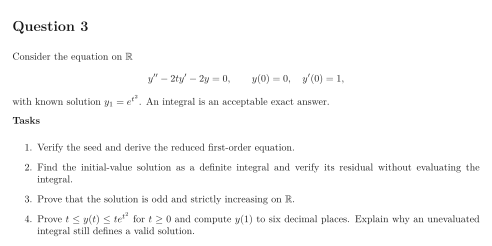
Step 4: Bound and evaluate. For , Multiplying by proves the bounds. Numerical integration gives . The integrand is smooth, so the definite integral defines a smooth function on all of ; the exact residual check proves it solves the equation.
See the diagram in the original worksheet below.