Question 8
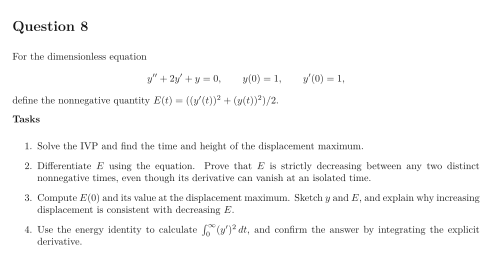
For the dimensionless equation define the nonnegative quantity .
Tasks
Solve the IVP and find the time and height of the displacement maximum.
Differentiate using the equation. Prove that is strictly decreasing between any two distinct nonnegative times, even though its derivative can vanish at an isolated time.
Compute and its value at the displacement maximum. Sketch and , and explain why increasing displacement is consistent with decreasing .
Use the energy identity to calculate , and confirm the answer by integrating the explicit derivative.
Show solutionHide solution
Question 8 – Solution
Strategy. Distinguish a coordinate’s amplitude from a quantity combining position and derivative, then integrate the exact dissipation identity.
Step 1: Solve and locate the transient maximum. The repeated root is . The data give and . Hence the unique displacement maximum is
Step 2: Derive and interpret dissipation. Differentiating and substituting gives The derivative vanishes only at . On any interval with , is positive except possibly at that one point, so its integral is strictly positive. Thus , proving strict decrease between distinct times.
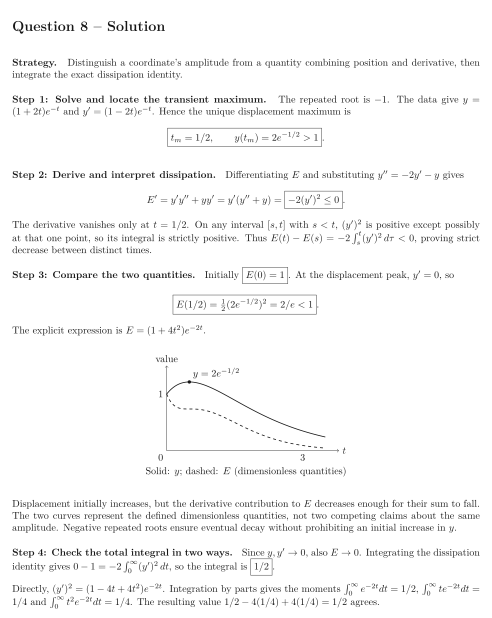
Step 3: Compare the two quantities. Initially . At the displacement peak, , so The explicit expression is .
See the diagram in the original worksheet below.
Displacement initially increases, but the derivative contribution to decreases enough for their sum to fall. The two curves represent the defined dimensionless quantities, not two competing claims about the same amplitude. Negative repeated roots ensure eventual decay without prohibiting an initial increase in .
Step 4: Check the total integral in two ways. Since , also . Integrating the dissipation identity gives , so the integral is .
Directly, . Integration by parts gives the moments , and . The resulting value agrees.